
In this guide
At a glance.
- On residential asphalt-shingle roofs, decking and sheathing commonly name the same structural wood base. Underlayment is separate.
- An allowance for new wood is a pricing provision, not proof that your roof has damaged panels.
- Compare the material, included quantity, billing unit, evidence and approval process before comparing quote totals.
Roof decking vs sheathing usually comes down to wording. On a residential asphalt-shingle roof, both terms commonly describe the structural wood base under the underlayment and shingles. They do not automatically mean two layers you have to buy.
What matters on a quote is the work attached to that name: which wood, how much, why it needs replacing and how you approve the charge. Here is how to compare those details without needing to become a roofing expert.
First, picture the layer
GAF’s roof decking explanation uses decking and sheathing as synonyms. Its August 2026 roof-system overview places underlayment above that structural base.
- 01Shingles
The outer roof covering.
- 02Underlayment
A separate layer above the wood.
- 03Decking / sheathing
The structural wood base, supported by framing.
A proposal listing sheathing and underlayment may simply be naming two different layers. A proposal listing “decking replacement” and “sheathing replacement” needs an explanation of the location, material and operation behind each line.
One phrase can be especially confusing: roof deck protection. GAF uses that wording for underlayment products. It does not, by itself, promise new wood. Ask for the product name when the heading leaves you guessing.
This guide concerns wood-deck homes with asphalt shingles. A metal or concrete deck, or a different roofing system, needs its own specification.
Compare the scope, not the vocabulary
Suppose two otherwise similar shingle quotes contain these lines. These are invented examples to show what to ask, not actual bids, inspection findings or recommended prices.
Quote A: an allowance is included
“Decking: includes replacement of up to two panels. Additional panels billed per sheet.”
You know that two panels are included. You still need the panel specification, the extra-work rate and the terms for any unused allowance.
Quote B: replacement is separate
“Sheathing: existing wood to remain where suitable. Replacement billed separately as needed.”
You know that replacement is outside the stated scope. You still need the billing unit, rate and explanation of what would make replacement necessary.
Neither short line is enough to choose a contractor. Read the rest of each proposal: a detail missing here may be explained elsewhere.
Make the quantities comparable first. Ask both companies to identify the existing wood, proposed replacement product and installed billing unit. Clarify whether the charge includes removal, installation and debris disposal.
Now imagine that three panels need replacement, the findings are documented and you authorize the work. The arithmetic would look like this:
| Same three-panel job | Included | Additional |
|---|---|---|
| Quote A | 2 panels | 1 panel |
| Quote B | None stated | 3 panels |
That does not prove A is cheaper. Its original total and extra-work rate still matter. It shows why the extra charge alone is a poor comparison.
If no panels need replacing, ask whether A’s unused allowance changes the bill. Do not assume a credit or refund; agree on that treatment before signing.
New shingles do not automatically mean all new wood
A shingle-replacement estimate is not evidence that every board or panel underneath needs replacement. Separate two questions:
- Condition: What is wrong with the existing wood, and where?
- Requirements: What does the proposed roofing system need at your address?
Owens Corning’s January 2026 specification guide calls for examining the deck, checking its condition and replacing damaged material. That is a condition-based instruction, not proof that your whole deck needs replacement.
It is a manufacturer’s specification guide. The instructions for your actual product and the requirements at your address still need checking. Ask the company to identify both when it explains the scope.
The opposite promise deserves scrutiny too: a quote written before the old roofing comes off cannot show you the condition of every concealed surface. Ask which areas have been inspected, which remain hidden and what happens if the findings change.
A useful estimate distinguishes known work from possible work. Replacing a photographed damaged panel near the rear eave names a location and reason. Including an allowance for possible panel replacement describes a pricing arrangement. Neither establishes the condition of the whole deck.
Get a quantity you can check
“Two sheets” sounds precise, but it leaves room for misunderstanding. Ask for the dimensions tied to that billing unit and whether a partial-panel repair is charged as a whole sheet.
You are clarifying the invoice, not telling the crew how to cut or install the material.
Boards and panels are different billing units
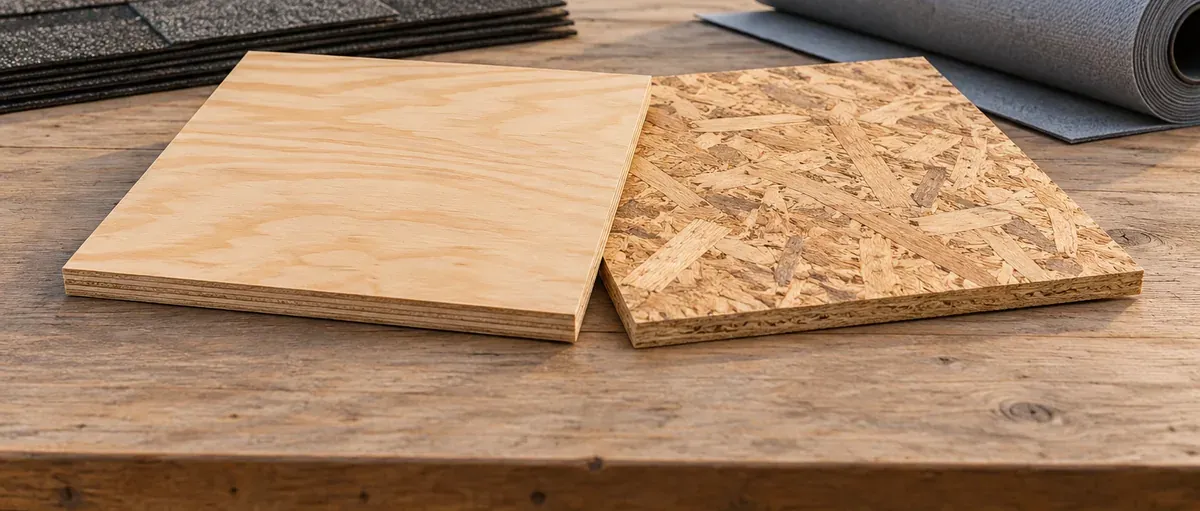
An older roof may have solid wood boards instead of plywood or oriented strand board, usually shortened to OSB. If one proposal prices board lengths and another prices panels, ask each contractor to describe the area and work being priced.
A length, a board count and a sheet count are not directly interchangeable. The company should explain its own calculation rather than expecting you to translate unlike quantities.
Replacement and an added layer are different jobs
If a proposal says “new sheathing,” ask whether existing wood will be removed or retained. Those are different scopes; the wording should make the intended work clear.
If the proposal includes an added layer, ask why it is proposed, what happens to unsuitable wood underneath and which requirements support that specific assembly. The material name alone does not answer those questions.
Before work starts, identify whether the quantity is measured, estimated or simply an allowance. At completion, ask for the quantity actually installed and where it went. A photo of delivered panels does not establish how many were used on your roof.
Ask for evidence, not just “bad decking”
That phrase is a conclusion. The explanation should connect a condition, a location and a quantity.
Ask the contractor for:
- A wider photo locating the area on your roof.
- A closer photo showing the concern.
- A written explanation of why that condition supports the proposed repair or replacement.
Photos help you follow the recommendation. They do not replace a qualified assessment, and a close-up of unidentified wood cannot explain the extent of an entire roof’s replacement.
Keep this review on the ground. GAF’s June 2026 leak guidance recommends ground-based homeowner inspections; ask the contractor to provide the roof evidence rather than climbing up yourself.
If moisture damage is the reason, add one more question: what will address the reported moisture source alongside the wood work? Ask the company to connect the proposed repair to its explanation of the problem.
That question does not mean other roof components need replacing. It helps you understand what the proposed work is intended to solve, and what remains outside its scope.
Check what supports the material recommendation
GAF’s 2026 guides identify plywood and OSB as roof-deck materials. The Owens Corning specification guide lists different requirements for wood boards and panels. A material name alone cannot establish whether the proposed product suits your roof.
Ask for the proposed material and specification in writing. If two bids use different products, ask what practical requirement explains the difference before assuming one is an upgrade.
Two useful follow-ups are:
- “The manufacturer requires it.” Ask for the relevant instruction for your actual shingle product.
- “Code requires it.” Ask for the applicable provision and how it applies at your address.
You can then discuss a disagreement with the manufacturer or local building department. You do not need to resolve technical design questions yourself; you need to understand whether the companies are pricing the same work for the same reason.
When two recommendations conflict
Put the explanations beside each other before comparing the totals. One company may be pricing a specific damaged area while another is proposing an added layer across a larger area. Those are different scopes, even if both use the word sheathing.
Ask each company to identify what the other proposal leaves unresolved. Is the disagreement about visible condition, concealed uncertainty, product requirements or the amount of work included? Request the evidence behind that answer. A clearer explanation gives you something useful to check; a blanket claim that the other bid is wrong does not.
Agree on the change process before tear-off
Settle the decision process before work starts. Tennessee’s May 2026 consumer guidance recommends written contracts that identify materials, allowances and change orders. Use that as a prompt to ask how a finding becomes an authorized change.
The request should give you the proposed work, quantity, unit rate, inclusions and added total. Agree who can approve it and how that person will be contacted during the job.
Accepting a per-sheet rate is not the same as authorizing an unlimited number of sheets. Ask what evidence and quantity will accompany each request for additional work.
Also discuss what happens if you cannot be reached promptly. How will the opened roof be protected, and could that work carry a separate charge? Settle the process before the crew is waiting on a decision.
Keep the original estimate, written changes, approvals, photos and final quantity record together. If the invoice changes “decking” to “sheathing,” compare the underlying material and operation. A different noun is not necessarily different work; a changed quantity or scope should have a corresponding explanation and authorization.
Compare local roofing listings
Bring the same wood-work questions to each company so you can compare their answers. Browse roofing company listings near your ZIP on Roofer Directory, then check applicable licensing or registration rules where you live. Connecticut’s April 2026 consumer checklist also recommends requesting current insurance documentation. Request an estimate from companies you have checked.
For related decisions, use our asphalt replacement cost guide, contractor selection guide, repair versus replacement guide and roofing FAQ.
Related guide: Can You Replace One Side of a Roof? Compare the Scope.
Related guide: Bathroom Fan Venting Into Attic? Define the Full Repair.
Related guide: How Long Can Roof Underlayment Be Exposed?.
Published by RooferDirectory. Learn about our sources and methods, or suggest a correction.