
In this guide
At a glance.
- Metal roofing now captures roughly 18% of the U.S. residential roofing market (Metal Roofing Alliance / FMI 2024 data), with re-roofing demand driving most of the growth. The U.S. metal roofing market is projected to grow from $5.4B (2025) to $8.0B (2035) at a 3.99% CAGR.
- A standing seam metal roof costs $10 to $18 per square foot installed in 2026 for steel or aluminum panels. For a 2,000 sq ft roof, that's $20,000 to $36,000, roughly 2 to 2.5 times the cost of architectural asphalt shingles upfront.
- Standing seam lasts 40 to 70 years vs. 20 to 30 years for architectural asphalt. Over 30 to 50 years, metal typically costs less per year than asphalt despite the higher upfront price, especially when insurance discounts are factored in.
- A UL 2218 Class 4 (highest impact resistance) metal roof can lower homeowners insurance by 5% to 35% depending on state. In hail-prone markets like Texas, Colorado, Oklahoma, and Kansas, discounts of 20% to 35% are common.
- The federal Section 25C tax credit was terminated December 31, 2025 by the One Big Beautiful Bill (Pub. L. 119-21). As of 2026, no federal tax credit applies to a metal roof itself. Energy savings come from utility bill reductions and insurance discounts, not federal tax incentives.
For decades, metal roofing in residential housing was associated with barns, mountain cabins, and specialty projects. That has changed. Per Metal Roofing Alliance / FMI / Freedonia data, residential metal roofing now captures roughly 18% of the U.S. roofing market, with 84% of all metal roof square footage in the country going on residential structures. The U.S. metal roofing market is projected to grow from $5.4 billion in 2025 to $8.0 billion by 2035, while the global metal roofing market is on track to reach $31.6 billion by 2034.
If you’re at the point of replacing a roof in 2026, metal is a real option, not a niche one. The question isn’t whether metal works (it does), it’s whether the math works for your specific home, climate, and time horizon.
This guide breaks down the actual 2026 cost of every major metal roofing type, the lifespan you can realistically expect, the insurance and energy economics, the downsides nobody mentions in the sales pitch, and a 30-year cost-of-ownership comparison against architectural asphalt so you can decide for your specific situation.
Why Metal Is Suddenly Mainstream
Three forces have pushed metal from specialty to mainstream over the last five years.
Insurance market pressure. As severe weather has gotten more expensive (the U.S. recorded $51 billion in insured losses from severe convective storms in 2025, the third straight year above $50B per Triple-I), carriers have aggressively pushed for more durable materials. The Florida Office of Insurance Regulation has publicly stated that asphalt shingle roofs often do not last as long as manufacturers claim. The Insurance Institute for Business & Home Safety (IBHS), in testimony to the Florida Senate Banking and Insurance Committee, noted that a 10-year-old asphalt shingle roof has a 1-in-12 chance of damage from 60 mph winds, and that the chance of damage rises to “nearly 100%” against 100 mph winds.
Cost compression. Standing seam metal pricing was $14 to $20 per square foot in many markets a decade ago. As more contractors learned the install (especially with the Metal Construction Association certification programs growing) and steel coating technology improved, that range has come down to $10 to $18 per square foot installed for steel or aluminum. The cost premium over architectural asphalt has narrowed enough that the lifetime math now favors metal for homeowners staying in their homes more than 15 years.
Solar integration. As residential solar adoption grows, standing seam metal has become the preferred substrate for solar arrays because clamps from manufacturers like S-5! attach to the seams without penetrating the roof. Per 2026 industry data, 29% of new residential metal roofs are now installed solar-ready or with solar already integrated.
The result: metal moved from “the contractor down the street probably won’t quote it” to a standard line item alongside architectural shingles in most American markets.
The 5 Types of Residential Metal Roofing
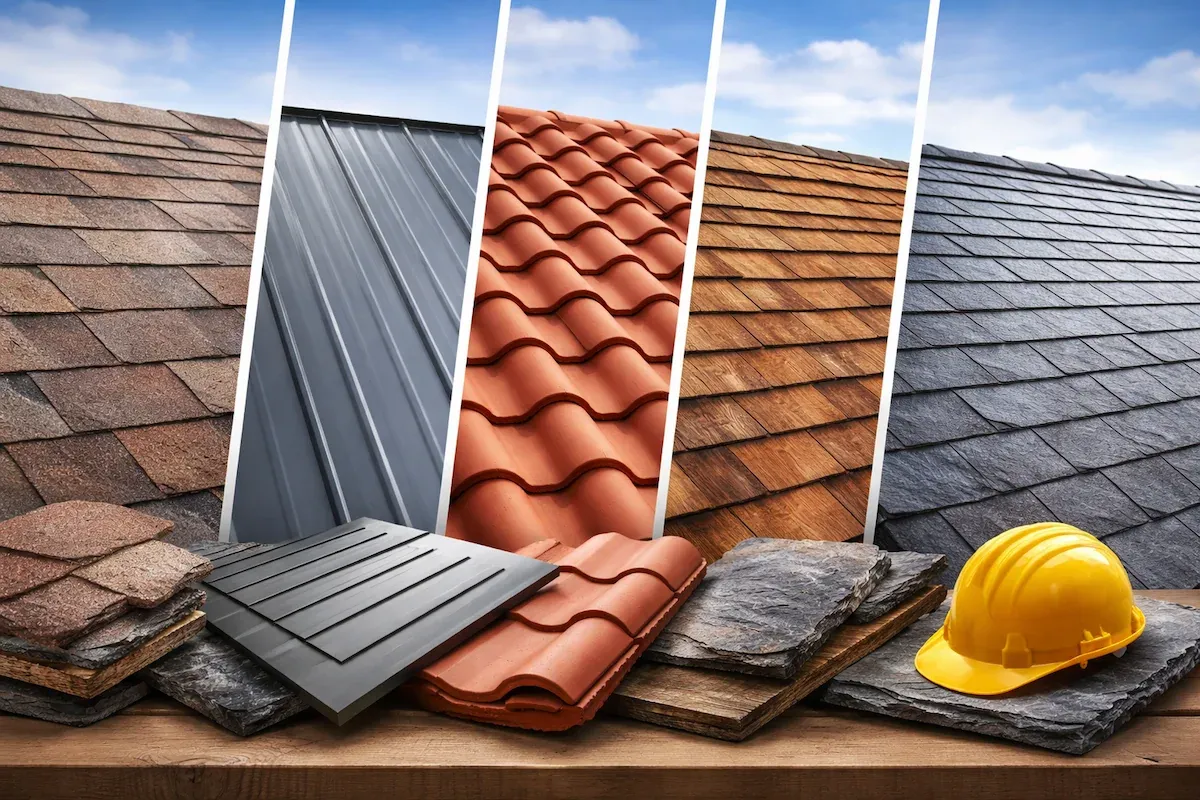
Before you can talk cost, you need to know what you’re pricing. There are five broad categories of residential metal roofing, each with different cost ranges, install methods, lifespans, and aesthetic profiles.
1. Standing Seam (the premium choice)
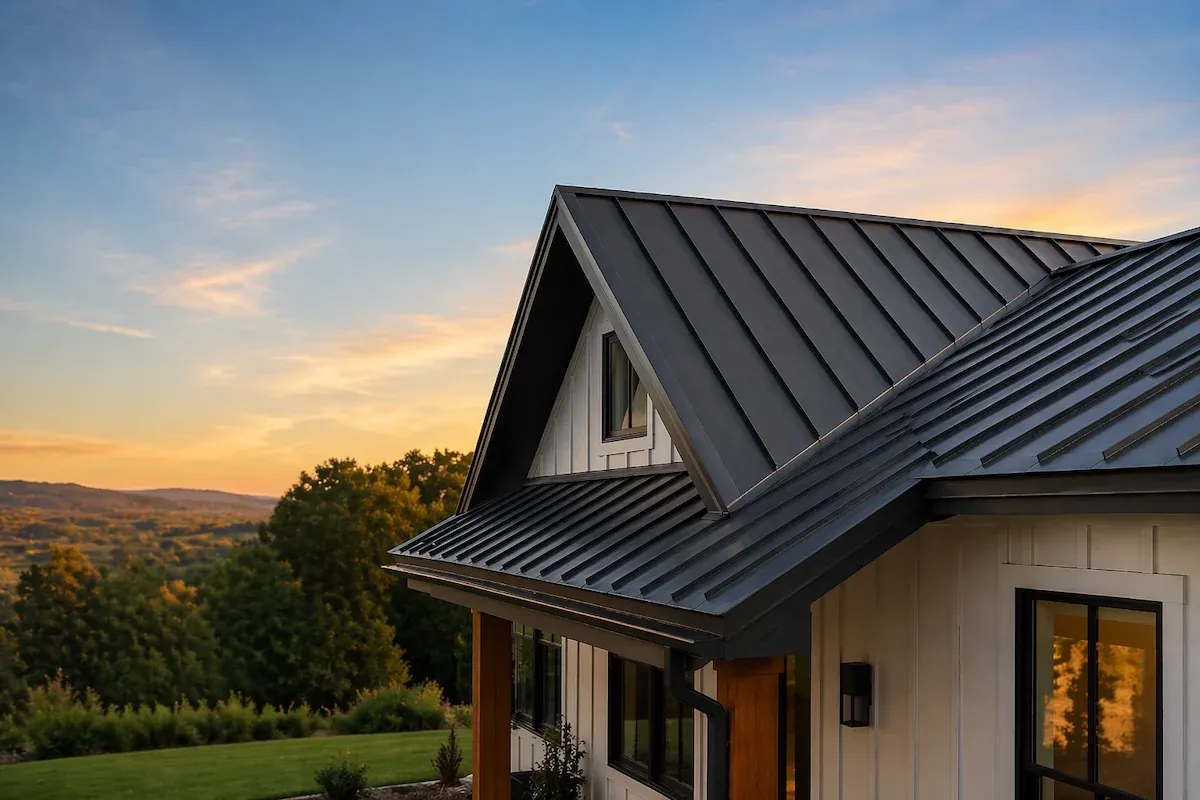
Standing seam panels lock together at raised seams, with all fasteners hidden underneath. This is the metal roof you see on modern coastal homes, contemporary architecture, and high-end traditional houses. It’s also the most expensive style to install because of the specialized panels, custom fabrication (often roll-formed on site), and skilled labor required.
- Cost installed: $10 to $18 per sq ft (steel/aluminum); $20 to $40 per sq ft (copper); $14 to $22 per sq ft (zinc)
- Lifespan: 40 to 70 years (steel/aluminum); 100+ years (copper, zinc)
- Best for: Long-term homeowners, coastal homes, modern architecture, solar-ready installations
2. Corrugated / Exposed-Fastener Panels
The classic ribbed metal panels installed with screws through the face of the panel. The cheapest way to get a metal roof. Common on barns, agricultural buildings, garages, and budget-conscious residential projects (especially in the South and Midwest).
- Cost installed: $4 to $12 per sq ft
- Lifespan: 25 to 45 years (with fastener replacement typically required at year 20)
- Best for: Outbuildings, budget residential projects, rural properties. Less ideal for primary residences in high-wind or coastal areas because the exposed fasteners and gaskets are the failure points.
3. Stamped Metal Shingles
Metal panels stamped to look like asphalt shingles, slate, or wood shake. Carries the durability and lifespan benefits of metal with an aesthetic that blends into traditional neighborhoods.
- Cost installed: $9 to $14 per sq ft
- Lifespan: 30 to 50 years
- Best for: HOA-restricted neighborhoods, traditional architecture where standing seam doesn’t fit aesthetically.
4. Stone-Coated Steel
Steel panels coated with a layer of stone granules, designed to mimic the appearance of clay tile, slate, or wood shake while delivering metal performance. Popular in the Sunbelt where tile aesthetics are desirable but tile weight is a structural challenge.
- Cost installed: $9 to $15 per sq ft
- Lifespan: 40 to 50 years
- Best for: Homes wanting a tile or shake aesthetic without the structural load (stone-coated steel weighs about 1.5 lb/sq ft, vs. 9-12 lb/sq ft for concrete tile).
5. Premium Specialty (Copper, Zinc, Terne)
Architectural-grade metals used on luxury homes, historic restorations, and signature projects. Copper develops a green patina over decades; zinc is self-healing (scratches re-patinate over time); terne is steel coated with a tin/lead alloy used historically and now mostly in restoration work.
- Cost installed: $20 to $40+ per sq ft
- Lifespan: 80 to 100+ years (often outlives the structure)
- Best for: High-end estate homes, historic restorations, signature architecture.
True Cost Per Square Foot in 2026 (Cross-Verified)
The numbers below are aggregated from multiple 2026 cost surveys (FMI/Freedonia industry data, MRA member estimates, contractor pricing data from cost calculators that cite their methodology). For comparison context, see our 2026 roof cost guide.
| Material | Cost / Sq Ft (Installed) | Total for 2,000 Sq Ft Roof | Lifespan |
|---|---|---|---|
| 3-Tab Asphalt (comparison) | $3.50–$5.50 | $7,000–$11,000 | 15–20 yrs |
| Architectural Asphalt (comparison) | $4.00–$8.00 | $8,000–$16,000 | 20–30 yrs |
| Corrugated/Exposed-Fastener Steel | $4.00–$12.00 | $8,000–$24,000 | 25–45 yrs |
| Stone-Coated Steel | $9.00–$15.00 | $18,000–$30,000 | 40–50 yrs |
| Stamped Metal Shingles | $9.00–$14.00 | $18,000–$28,000 | 30–50 yrs |
| Standing Seam Steel/Galvalume | $8.00–$16.00 | $16,000–$32,000 | 40–70 yrs |
| Standing Seam Aluminum | $11.00–$17.00 | $22,000–$34,000 | 50+ yrs |
| Standing Seam Zinc | $14.00–$22.00 | $28,000–$44,000 | 80–100+ yrs |
| Standing Seam Copper | $20.00–$40.00 | $40,000–$80,000+ | 100+ yrs |
Regional adjustments apply. Standing seam in Phoenix or Houston often runs at the lower end of these ranges due to high local install volume; in higher-cost coastal markets (San Francisco, New York metro, Boston), expect 15-25% above national midpoint.
The 30-Year Cost-of-Ownership Math
Sticker price is the wrong number to focus on. What matters is total cost over the time you’ll own the home, including the cost of replacing asphalt at least once over the lifespan of a single metal roof.
Here’s the math for a 2,000 sq ft roof, 30-year ownership horizon, comparing architectural asphalt shingles against standing seam steel.
| Cost Category | Architectural Asphalt | Standing Seam Steel |
|---|---|---|
| Initial installation | $12,000 | $24,000 |
| Replacement at year 22-25 (asphalt only) | $14,000–$18,000 (with inflation) | $0 |
| Repairs over 30 years | $4,000–$8,000 | $1,500–$3,000 |
| Maintenance over 30 years | $1,500–$3,000 | $500–$1,500 |
| Insurance savings (15% Class 4 + wind, 30 yrs at $1,800 base) | $0 | $8,100 (-) |
| Energy savings (cool roof, 30 yrs typical) | $0 | $3,000–$9,000 (-) |
| 30-Year Total Cost of Ownership | $31,500–$43,000 | $14,400–$23,400 |
The numbers vary by market, energy rates, and insurance carrier, but the overall pattern holds: a standing seam metal roof installed for 1.5-2x the upfront cost of architectural asphalt typically delivers about half the 30-year total cost of ownership.
This logic only applies if you stay in the home long enough to capture the value. Selling within 5 years? You won’t get the asphalt-replacement-avoided benefit, and home buyers don’t always pay a price premium proportional to the metal roof’s remaining service life. Angi data does suggest a metal roof adds roughly 6% to resale value, which mostly recoups the upfront premium for shorter-term owners.
For a deeper material-by-material lifespan comparison, see how long a roof lasts by material type.
Insurance Discounts: The Single Biggest 2026 Tailwind
Insurance pricing has shifted dramatically in favor of metal over the last three years, and the trend is accelerating. Cotality (formerly CoreLogic) projects U.S. homeowners insurance premiums will rise 8% in 2026 and another 8% in 2027, driven largely by severe weather losses. Class 4 impact-rated metal sits on the right side of that trend.
Discount Structure by Region
| Region | Typical Discount on Dwelling | Notes |
|---|---|---|
| Hail Alley (TX, OK, KS, CO, NE) | 20% to 35% | Class 4 + UL 2218 documentation typically required. Stacks with mitigation credits. |
| Coastal Hurricane Zones (FL, NC, SC, GA, LA, MS, AL) | 5% to 15% | Often combined with wind mitigation credits (FORTIFIED, FL Form OIR-B1-1802). |
| Tornado Belt (OK, AR, MO, TN, AL, MS) | 10% to 25% | Wind ratings 110-140 mph are the unlock. |
| Wildfire Zones (CA, OR, CO, MT) | 5% to 20% | Class A fire rating drives the discount. |
| Lower-Risk Markets (Northeast, Pacific NW) | 0% to 10% | Smaller discounts but Class 4 still recognized by major carriers. |
How to Maximize Your Discount
- Specify Class 4 (UL 2218) when ordering the roof. Not all metal panels carry the rating; verify the manufacturer’s certification before signing the contract.
- Confirm Class A fire rating with the manufacturer. Most quality metal roofs achieve this, but some lower-end products don’t.
- Document the install. Get the manufacturer certification, contractor invoice, and any third-party inspection (FORTIFIED, wind mitigation form) in writing.
- Submit documentation to your carrier. The discount doesn’t apply automatically; you have to file the paperwork. Many homeowners install Class 4 roofs and never claim the discount.
- Combine with FORTIFIED if available. In states where IBHS FORTIFIED is recognized, the FORTIFIED Roof tier discount can stack with the Class 4 discount for total savings of 25-55%.
For homeowners in hail-prone metros like Dallas, Denver, Oklahoma City, and Colorado Springs, the insurance math alone often justifies the metal premium.
The Energy Efficiency Story (Real, but Modest)
Metal roofing is reflective. Steel and aluminum panels with appropriate coatings reflect 20% to 80% of solar radiation depending on color and finish, vs. 5% to 30% for asphalt shingles. In hot climates, this translates to lower attic temperatures and reduced HVAC load.
The honest range of energy savings from a cool-coated metal roof:
- Hot climates (FL, AZ, TX, southern CA): 7% to 25% reduction in annual cooling costs
- Mild climates (most of the country): 3% to 10% cooling cost reduction
- Cold climates (northern tier states): Negligible cooling savings; some heating cost increase possible (offset by other factors)
On a $1,500 annual cooling bill in a hot climate, a 15% reduction is $225 per year. Over a 50-year metal roof lifespan, that’s $11,250 in cumulative cooling savings, before factoring in utility rate inflation.
Important note about federal tax credits: As of April 2026, no federal tax credit applies to a metal roof itself. The Section 25C Energy Efficient Home Improvement Credit was terminated December 31, 2025 by the One Big Beautiful Bill (Public Law 119-21, signed July 4, 2025). Even before that termination, the specific metal-roof provision in §25C had been struck out by the 2022 Inflation Reduction Act, so metal roofs themselves were not directly eligible for federal credits during the 2023-2025 window either. Some state and utility rebate programs still apply to cool-roof installations or solar-integrated systems; check with your state energy office.
What Metal Doesn’t Tell You in the Sales Pitch
Metal is genuinely durable, but it has real downsides that get glossed over in marketing material.
Oil canning. This is the visible waviness or rippling on flat sections of standing seam panels, especially in raking light. It’s a natural function of metal’s expansion and contraction and is considered an aesthetic characteristic, not a structural defect. Manufacturers minimize it with rib rolling, striations, or thicker-gauge panels, but you’ll never fully eliminate it. Most metal roof warranties specifically exclude oil canning.
Denting from large hail or fallen objects. Metal handles 1-inch and 1.5-inch hail without functional damage; it does not crack like asphalt or shatter like tile. But large hail (2 inches and up) can leave dents in the panels that are aesthetic, not functional. The roof keeps water out; it just looks beat up. Insurance Class 4 ratings cover the functional resistance, not the cosmetic dents. Some carriers explicitly exclude “cosmetic-only” metal damage from claims, which is something to check before buying coverage.
Repair complexity. A metal roof repair requires a contractor experienced with metal systems. Replacing a single panel section is harder than swapping an asphalt shingle, the colors may not match exactly if the original panels have weathered, and small repair jobs are harder to find a contractor for than asphalt repairs. This is one reason starting with a quality install (and a contractor with a long warranty) matters more on metal than on shingles.
Walkability. Some metal panel profiles are walkable (you can step on them carefully without damaging the panel); others (thinner-gauge corrugated, lightweight stamped shingles) are not. If you’ll need roof access for HVAC, antennas, or holiday lights, ask about walkability before specifying.
Snow shedding. Standing seam metal sheds snow rapidly and predictably, which is great for preventing ice dams but can be dangerous if there’s a walkway or driveway directly below an eave. Snow guards (small clips installed near the eaves) prevent dangerous slides. Budget for them in snowy climates.
Lightning is not actually a concern. A common myth: metal roofs do not attract lightning, do not increase strike risk, and (per the National Fire Protection Association) actually reduce the risk of lightning-caused fire because metal conducts the strike to ground without igniting the roof.
Choosing the Right Installer (More Important on Metal than on Asphalt)
Metal installation is less forgiving than shingle installation. A poorly seamed standing seam roof will leak; a poorly fastened corrugated roof will lift in high winds. The contractor selection matters more here than it does on a simple asphalt re-roof.
What to look for:
Manufacturer certification. Major metal manufacturers (McElroy Metal, ATAS, Englert, Petersen/PAC-CLAD, Drexel Metals) run installer certification programs. Certified contractors install to specs that activate enhanced manufacturer warranties (often 30 to 50 years on the panel finish). Ask for certification documentation, not just verbal claims.
Trade association membership. The Metal Construction Association (MCA) is the dominant U.S. metal roofing trade association. The Metal Roofing Alliance (MRA) is the consumer-facing nonprofit; member contractors are typically reviewed for quality. Both memberships are useful signals, not absolute proof.
Track record on metal specifically. A general roofer who’s done 5 metal jobs in 10 years is not what you want. Look for contractors whose portfolio is at least 30% metal, with photographic evidence of completed projects.
Standing seam fabrication capability. The premium contractors roll-form panels on site to match exact roof dimensions. Off-the-shelf panel-only contractors can also deliver good work, but on-site forming reduces seams and waste.
For full vetting steps (license, insurance, BBB record, scam red flags), see our guides on how to choose a roofing contractor and storm chasers and roofing scams.
When Metal Is the Wrong Choice
Metal isn’t right for everyone. Walk away from a metal pitch if any of these apply:
- You’re selling within 5 years and your neighborhood is 95% asphalt shingle. You won’t recoup the premium, and the aesthetic may turn off some buyers.
- HOA restrictions explicitly prohibit metal. This is more common in older traditional neighborhoods than people expect. Check before you specify.
- The roof structure can’t be evaluated. If the existing decking is in unknown condition, the cost of full deck replacement plus metal can blow the budget. Sometimes architectural asphalt is the right call.
- Your contractor has minimal metal experience. A bad metal install is worse than a good asphalt install. If you can’t find a competent local metal installer at a reasonable price, the right answer might be a quality architectural shingle.
- The aesthetic is genuinely wrong for the home. A 1920s Tudor or a Mediterranean Revival looks better in slate, tile, or shake than in standing seam.
For homeowners weighing repair against full replacement on an existing roof (where metal is one of the replacement options), our repair vs replacement guide walks through the decision framework.
The Decision Framework
If you’re trying to decide whether metal is right for your home in 2026, run through this list:
Choose metal if:
- You plan to stay in the home 15+ years.
- You live in a hail-prone, hurricane-prone, or wildfire-prone market where insurance discounts will materially offset the premium.
- Your home’s architecture supports metal aesthetically (modern, contemporary, coastal, mountain, agricultural).
- You’re planning to add solar in the next 5 to 10 years.
- You can find a certified, experienced metal installer at a competitive price.
Choose architectural asphalt if:
- You’re selling within 5 years.
- Budget is the primary constraint and you can’t comfortably absorb the metal premium.
- The neighborhood is uniformly shingle and metal would stand out negatively.
- Your structure is in unknown condition and the deck repair budget is uncertain.
- A high-quality metal installer isn’t available in your local market.
For the broader cost framework (asphalt-focused), see how much a new roof costs in 2026. For local Florida-specific metal vs tile decisions, see best roofing for Florida homes.
Get Real Metal Roof Quotes from Licensed Local Contractors
Metal pricing varies meaningfully by market, contractor experience, and the specific panel system specified. The only way to get an accurate number for your home is to compare line-item written estimates from licensed local contractors who quote metal regularly.
Find top-rated roofing contractors near you on Roofer Directory. Filter by your zip code, compare ratings and reviews, and connect directly with professionals who serve your area. Or request a free estimate from a local roofer in your zip code.
For more on the broader 2026 roofing landscape, our guides cover how much a new roof costs, how long each material lasts, hail damage insurance claims, the best roofing for Texas homes, and the FAQ and glossary for everything else.
A few more answers.
How much does a metal roof cost in 2026?
A standing seam metal roof costs $10 to $18 per square foot installed for steel or aluminum, putting a 2,000 sq ft roof at $20,000 to $36,000. Corrugated/exposed-fastener panels run $4 to $12 per square foot installed. Premium metals like copper ($20 to $40 per sq ft) and zinc ($14 to $22 per sq ft) cost substantially more. By comparison, architectural asphalt shingles run $4 to $8 per square foot installed.
How long does a metal roof last?
Standing seam metal roofs (steel with quality coatings or aluminum) last 40 to 70 years. Corrugated/exposed-fastener metal lasts 25 to 45 years, with fastener replacement typically needed at year 20. Stamped metal shingles last 30 to 50 years. Copper and zinc roofs routinely last 80 to 100+ years and have documented service lives exceeding a century. By comparison, architectural asphalt shingles last 20 to 30 years.
Is metal roofing worth the higher upfront cost?
It can be worth considering for its service-life potential, appearance and suitability for your climate. Compare complete installed prices, expected maintenance, warranties and how long you plan to own the home. There is no universal payback period or resale return for every metal roof.
Does a metal roof lower my homeowners insurance?
Some insurers offer credits for qualifying roof characteristics, but metal alone does not guarantee a discount. Ask your insurer about the exact system, required documentation and any cosmetic-damage exclusion. Compare the full premium and coverage before including savings in your budget.
What is UL 2218 Class 4?
UL 2218 is the Underwriters Laboratories standard for impact resistance of roofing materials. Class 4 is the highest rating, achieved when a roofing assembly shows no cracking, splitting, or tearing after a 2-inch steel ball is dropped from 20 feet (simulating large hail). Most quality metal roofs achieve Class 4. The rating is what unlocks the largest insurance discounts in hail-prone regions.
Will a metal roof rust?
Quality metal roofing materials are designed to resist rust for decades. Galvalume (steel coated with aluminum-zinc) is the standard residential steel coating and resists rust extremely well in most climates. Aluminum doesn't rust at all and is the preferred choice in coastal salt environments. Bare galvanized steel will eventually pit and fail in coastal exposure, which is why coastal homes should specify galvalume or aluminum, not bare galvanized.
Are metal roofs noisy in the rain?
Modern residential metal roofs installed over solid sheathing with proper underlayment are not meaningfully louder than other roofing materials. The 'tin roof in the rain' sound comes from old barn construction with metal panels installed over open framing or thin decking. With standard residential installation (1/2 inch or thicker plywood/OSB sheathing, synthetic underlayment, attic insulation), interior noise levels are comparable to asphalt or tile.
Can I install a metal roof over my existing shingles?
In some cases, yes, depending on local building codes and the condition of the existing roof. Many jurisdictions allow a single layer of metal panels installed over an existing layer of asphalt shingles, often with furring strips for ventilation. However, most roofing professionals recommend a full tear-off to inspect and repair the deck, install fresh underlayment, and avoid trapping moisture between layers. The cost difference is typically modest, and the long-term performance is better with a tear-off.
Can I add solar to a metal roof?
Often, with a mounting system designed for the specific roof. Some standing-seam systems allow clamps that avoid new panel penetrations, but compatibility and installation still matter. Have the solar installer and roofer agree on loads, attachments, weatherproofing and warranty responsibilities.
Are there any tax credits for installing a metal roof in 2026?
Do not budget for a federal credit simply because the roof is metal or reflective. IRS guidance limits the Energy Efficient Home Improvement Credit to qualifying improvements through December 31, 2025. Check current state or utility programs and confirm eligibility with a tax professional before relying on an incentive.
What is oil canning and is it a defect?
Oil canning is the visible waviness or rippling that can appear on flat sections of metal panels, especially on standing seam in low light. It is a function of the natural expansion and contraction of metal and is considered an aesthetic characteristic, not a structural defect. Manufacturers use techniques like rib rolling, striations, or thicker gauges to minimize oil canning. Most metal roof warranties specifically exclude oil canning.
More questions? Browse the roofing FAQ & glossary.
Selected FAQ answers reviewed .
Published by RooferDirectory. Learn about our sources and methods, or suggest a correction.