

How Much Does a New Roof Cost? (2026 Pricing Guide)

What a new roof actually costs in 2026. Material pricing, labor breakdown, hidden fees, regional differences, and how to avoid overpaying.

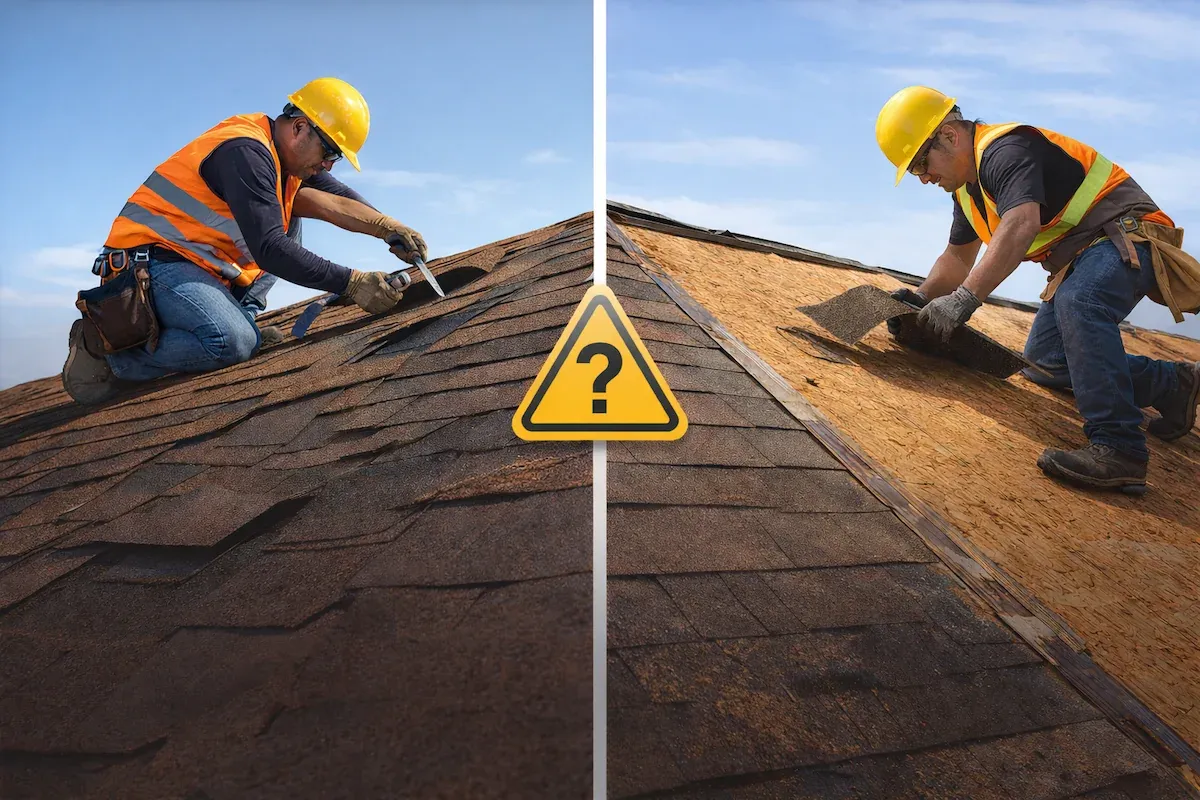
Roofing cost breakdown showing material samples and contractor estimate paperwork on a table
Highlights
  • The national average for a full roof replacement in 2026 is approximately $9,500 for asphalt shingles, though total costs range from $5,800 to $46,000+ depending on material and roof complexity.
  • Labor accounts for 40% to 60% of your total roofing bill. Regional differences are significant: the same roof that costs $8,000 in the South might run $14,000 on the West Coast.
  • Material costs per square foot (installed) range from $3.50 for basic 3-tab shingles up to $30+ for natural slate, with architectural asphalt sitting in the $4.50 to $7.50 range.
  • Permits, tear-off, decking repairs, and dumpster fees can add $1,500 to $4,000+ to your project. If these aren't itemized in your estimate, you're going to get surprised.
  • Financing a roof through a HELOC (averaging 7.20% APR in early 2026) almost always beats contractor-arranged financing, which can carry rates above 15% APR after the promo period ends.

A new roof isn’t a purchase anyone gets excited about. Nobody scrolls through shingle catalogs for fun. But when it’s time, it’s time, and the first question is always the same: what is this going to cost me?

The honest answer is that it depends. Roof pricing is driven by a handful of specific variables, and those variables swing the number dramatically. The same house could get a new roof for $7,000 or $25,000, and both quotes could be legitimate depending on the material, the market, and what’s happening underneath the old shingles.

This guide breaks down exactly where your money goes when you replace a roof in 2026. Real numbers, real ranges, and the stuff that doesn’t always show up in the initial estimate.


The National Average (and What It Actually Tells You)

The national average for a full roof replacement in 2026 sits at approximately $9,500. That number gets cited constantly across the industry, and it’s useful as a benchmark, but it can also be misleading if you take it at face value.

That average is heavily weighted toward standard-sized homes (roughly 1,500 to 2,000 square feet of roof area) with asphalt shingle roofs on a moderate pitch. If your roof is bigger, steeper, more complex, or you want anything other than basic shingles, you’re going to come in above it. In practice, most homeowners spend somewhere between $5,800 and $15,000 for an asphalt shingle replacement, and projects involving metal, tile, or slate roofing can push well past $30,000 to $46,000+.

The number that matters isn’t the national average. It’s the number on your estimate, broken down line by line so you can see exactly what you’re paying for.


Cost by Material

Material choice is the single biggest lever you have on the total price. Here’s what each option costs per square foot installed in 2026, along with total project estimates for a typical 2,000-square-foot roof.

MaterialCost Per Sq Ft (Installed)Typical Total (2,000 Sq Ft Roof)Expected Lifespan
3-Tab Asphalt Shingles$3.50–$5.50$7,000–$11,00015–20 years
Architectural Asphalt Shingles$4.50–$7.50$9,000–$15,00025–30 years
Premium/Impact-Resistant Shingles$6.50–$9.00$13,000–$18,00025–30 years
Metal (Standing Seam)$8.00–$16.00$16,000–$32,00040–70 years
Metal (Corrugated/Exposed Fastener)$5.00–$9.00$10,000–$18,00025–40 years
Clay Tile$15.00–$22.00$30,000–$44,00050–100+ years
Concrete Tile$10.00–$18.00$20,000–$36,00040–75 years
Natural Slate$20.00–$30.00+$40,000–$60,000+75–150 years
TPO (Flat Roof)$5.00–$9.00$10,000–$18,00015–25 years
EPDM (Flat Roof)$4.50–$8.50$9,000–$17,00020–30 years

These ranges include both materials and labor. They don’t include permits, tear-off, decking repair, or other ancillary costs, which we’ll get to.

For a full comparison of how long each material actually lasts (and what affects those numbers), our guide on roof lifespan by material type has the complete breakdown.


Cost by Roof Size

Your roof area is measured in “squares,” which is an industry term for 100 square feet. Most contractors quote per square rather than per square foot because it standardizes pricing.

Here’s what architectural asphalt shingle replacement typically costs by roof size in 2026:

Roof AreaSquaresTypical Cost Range
1,000 sq ft10$5,000–$8,500
1,500 sq ft15$7,000–$12,000
2,000 sq ft20$9,000–$15,000
2,500 sq ft25$11,500–$19,000
3,000 sq ft30$14,000–$23,000
3,500 sq ft35$16,000–$27,000

One thing homeowners don’t always realize: your roof area is not the same as your home’s floor plan. Roof area is larger because it accounts for the slope. A 1,500-square-foot ranch with a moderate pitch might have 1,800 to 2,000 square feet of actual roof surface. Steep roofs add even more. Your contractor will measure the actual roof area (usually with satellite software or on-site measurements) before quoting.


Where the Money Goes: Labor vs. Materials

Understanding the cost split helps you evaluate whether an estimate is reasonable.

Labor accounts for 40% to 60% of a typical roofing project. Roofers in most markets charge between $2.50 and $4.50 per square foot for installation labor, with rates running higher on steep or complex roofs. Emergency work and winter installations carry premiums of 50% to 100% above standard rates.

Materials make up the rest. For architectural asphalt shingles, material costs run roughly $100 to $130 per bundle (three bundles cover one square). Underlayment, flashing, drip edge, pipe boots, ridge cap, and starter strip are all separate material line items.

Here’s why this matters: when you see two estimates that are $3,000 apart, the difference is almost always in the labor column, the materials spec, or the scope. A contractor using the same shingles as their competitor but charging significantly less is either running a leaner operation or cutting corners somewhere. The materials have a fairly fixed cost. It’s the labor, scope, and overhead that create the price variation.


Regional Pricing: Location Changes Everything

The same roof that costs $8,000 in Birmingham might cost $14,000 in San Francisco. Geography drives pricing more than most homeowners expect, and it’s not just about labor rates. Local building codes, permit requirements, climate-specific materials, and market demand all play into it.

High-cost markets include California ($6.00 to $12.50/sq ft), New York ($5.50 to $11.00/sq ft), and most of the Northeast. Urban areas within these states push even higher.

Mid-range markets include Florida ($5.00 to $10.00/sq ft), Texas ($4.00 to $8.00/sq ft, covered in depth in our Texas roof cost guide), and Illinois ($4.25 to $7.50/sq ft). Storm-prone markets like Dallas (which averages 190 hail events per year) and Miami can see price spikes after severe weather when demand surges and contractors are stretched thin.

Lower-cost markets include much of the Southeast and Midwest. States like Georgia, Ohio, Oklahoma, Alabama, and Kansas tend to run $3.50 to $6.50 per square foot. Markets like Denver fall in between, with moderate labor rates but code requirements for ice-and-water shield and ventilation standards that add to material costs.

The regional breakdown matters when you’re reading advice online. An article saying “a new roof costs $9,500” isn’t wrong, but it might be wildly off for your zip code. Get local estimates. National averages are a starting point, not a budget.


The Costs Nobody Mentions Until You’re Already Committed

Here’s where a lot of homeowners get stung. The headline number on your estimate covers materials and labor for the new roof. But there are several costs that can add $1,500 to $4,000+ to your total, and some contractors don’t itemize them upfront.

Tear-off and disposal. Removing the old roof and hauling it away typically runs $1.00 to $2.50 per square foot, or about $1,000 to $2,500 for a standard home. Some contractors bake this into their per-square price. Others list it separately. If your roof has two layers of shingles (the maximum most codes allow), tear-off costs go up 30% to 50% because of the extra labor and disposal weight.

Decking repair. Once the old shingles come off, the crew inspects the plywood or OSB sheathing underneath. Water-damaged, soft, or delaminated sections have to be replaced before the new roof goes on. Plywood replacement runs $50 to $100 per sheet, and a roof with chronic leak issues might need several sheets replaced. This is the most common source of mid-project price increases. A good contractor will give you a per-sheet rate in the contract and explain how they’ll handle the approval if extra decking work is needed.

Permits. A roofing permit is required in most jurisdictions and typically costs $150 to $600. Your contractor should handle the application (if they ask you to pull the permit yourself, that’s a red flag). In high-wind zones like South Florida, stricter product approval reviews and inspections push permit costs toward the upper end.

Dumpster rental. If not included in the contractor’s scope, a roll-off dumpster for roofing debris runs $300 to $500. Larger roofs or multi-layer tear-offs may need more than one.

Code-required upgrades. Depending on when your home was last roofed, current building codes may require additions that weren’t part of the original installation: ice-and-water shield along the eaves (required in cold climates), upgraded ventilation, specific drip edge profiles, or improved flashing details. These aren’t optional upsells. They’re code, and they add cost.

Flashing and pipe boot replacement. Reusing old flashing and pipe boots on a new roof is a common corner-cutting move. Proper practice is to replace all flashing, pipe boots, and drip edge during a full replacement. If your estimate doesn’t include these items, ask why.

Before you sign anything, make sure the estimate breaks out every line item and addresses how change orders (like unexpected decking damage) will be priced and approved. Our guide on choosing a roofing contractor covers what a proper estimate and contract should look like.


How to Compare Estimates Without Getting Fooled

Getting three estimates is standard advice. But three numbers on three pieces of paper don’t tell you much if the scope behind each number is different.

Line them up side by side. Create a simple comparison: materials (brand and product line), labor, tear-off, decking repair rate, permits, cleanup, warranty terms, and timeline. You’ll quickly see where each bid differs.

Watch for scope differences. A contractor who comes in $2,000 under the competition might be quoting 3-tab shingles instead of architectural, reusing old flashing instead of replacing it, or excluding tear-off and listing it as an add-on. The cheapest number isn’t the cheapest roof if it leaves work undone.

Ask about the shingle product line. Not all architectural shingles are created equal. GAF Timberline HDZ, CertainTeed Landmark, and Owens Corning Duration are the three most widely installed architectural shingle lines in the U.S. They’re all solid products, but their pricing tiers differ, and so do their warranty structures. Know what you’re getting.

Verify what “warranty” actually means. Two warranties are in play on every roofing project: the manufacturer warranty on the materials (typically 20 to 50 years) and the contractor’s workmanship warranty on the installation (typically 2 to 10 years). Some contractors advertise the manufacturer warranty prominently while offering only a 2-year workmanship warranty. Both matter. Both should be in writing.

Don’t pay to be someone’s first customer. A contractor with zero reviews and a brand-new business license might be perfectly competent, or they might be a storm chaser operating under a fresh name. Established contractors with verified track records are worth the premium. You can search licensed roofers in your area to compare options.


Cost Per Year: The Number That Actually Matters

Sticker price is what you pay today. Cost per year of service is what the roof actually costs you over time. This reframes the entire material decision.

MaterialInstalled Cost (2,000 Sq Ft)LifespanCost Per Year
3-Tab Asphalt$7,000–$11,00015–20 yrs$350–$733
Architectural Asphalt$9,000–$15,00025–30 yrs$300–$600
Standing Seam Metal$16,000–$32,00040–70 yrs$229–$800
Clay Tile$30,000–$44,00050–100 yrs$300–$880
Natural Slate$40,000–$60,00075–150 yrs$267–$800

The cheapest roof upfront (3-tab asphalt) is often the most expensive roof per year because you’re replacing it twice in the time a metal roof is still going. A standing seam metal roof at $20,000 that lasts 50 years runs $400 per year. An asphalt roof at $10,000 that lasts 25 years runs $400 per year too, but then you need another $10,000 roof. Over 50 years, the asphalt path cost you $20,000 versus the metal roof’s $20,000, except you also paid for two tear-offs, two permit rounds, and two weeks of disruption.

This doesn’t mean everyone should buy a metal roof. Upfront budget constraints are real, and if you’re selling the house in five years, a 50-year roof is overkill. But if you plan to stay in your home long-term, running the cost-per-year math can change which material makes the most sense. For help thinking through material lifespans, see our full comparison of how long each roofing material lasts.


Ways to Save Without Cutting Corners

There are legitimate ways to reduce your roofing bill. There are also ways that look like savings but cost you more in the long run. Here’s how to tell the difference.

Time it right. Roofing demand is seasonal. Late fall and winter (outside of emergency situations) are typically the slowest months for residential roofers. You can often negotiate better pricing or faster scheduling during off-peak windows. Spring and summer, especially after storm season, are the most expensive times to need a roof.

Choose your material strategically. You don’t need the most expensive shingle on the shelf. Mid-tier architectural shingles from any of the major manufacturers (GAF, CertainTeed, Owens Corning) offer excellent performance at a reasonable price point. Jumping to a premium line adds cost that doesn’t always translate proportionally into extra lifespan.

Don’t over-improve for your market. If every roof on your block is asphalt shingles and you install a $40,000 slate roof, you won’t recoup that at resale. Match your investment to the neighborhood and your timeline. A new asphalt shingle roof recoups roughly 60% to 70% of its cost at resale. Spending more than the neighborhood supports is a losing proposition.

Ask about manufacturer certification programs. GAF Master Elite, CertainTeed SELECT ShingleMaster, and Owens Corning Platinum Preferred contractors sometimes get pricing advantages on materials. More importantly, using a certified installer can unlock enhanced manufacturer warranties (longer coverage, transferability to new owners) at little to no additional cost.

Don’t skip maintenance on your current roof. If your roof isn’t at the end of its life yet, proper maintenance can add 5 to 15 years to its lifespan. Clean gutters, prompt repairs, and adequate ventilation are the difference between a roof that lasts 20 years and one that lasts 30. That’s a $9,500 replacement you delay for a decade by spending a few hundred dollars a year on upkeep.

Know the difference between repair and replacement. Not every roof problem requires a new roof. If the damage is localized and your roof has plenty of life left, a $500 repair is obviously better than a $9,500 replacement. Our guide on roof repair vs. replacement walks through the decision framework, including the 30% rule that separates a smart repair from throwing money at a dying roof.


Financing: How to Pay for It

A new roof is one of those expenses that rarely comes at a convenient time. Here are the main ways homeowners pay for them, ranked roughly by cost of borrowing.

Cash or savings. If you have it, this is obviously the cheapest path. No interest, no monthly payments, no risk.

Insurance proceeds. If your roof was damaged by a covered event (storm, hail, wind, fallen tree), your homeowners insurance likely covers some or all of the replacement. The average insurance payout for wind and hail damage is approximately $13,000, which covers a full asphalt shingle replacement for most homes. File promptly, document everything, and don’t accept the adjuster’s number without getting your own inspection.

Home equity loan or HELOC. If you have equity in your home, this is typically the next best option. Home equity loan rates are averaging around 7.47% APR in early 2026, with HELOCs averaging 7.20% APR. Some lenders offer introductory HELOC rates as low as 5.99% for the first 12 months. Interest may be tax-deductible if the funds are used for home improvement (consult a tax professional).

Personal loan. Unsecured personal loans don’t put your home at risk as collateral, but rates are higher, ranging from 5.99% to 36% APR depending on your credit. Approval is usually fast, sometimes within a day, which makes personal loans an option for urgent situations.

Contractor financing. Many roofing companies offer financing through third-party lenders. These often come with promotional periods of 0% interest for 6 to 18 months, which sounds great. But read the fine print. Once the promo period ends, interest rates can jump to 15% to 25% APR or higher. If you can pay off the balance within the promo window, it’s a reasonable deal. If you can’t, you’re better off with a HELOC.

Whatever you choose, decide what your roof needs first, then figure out how to pay for it. Don’t let a monthly payment structure make an unnecessary replacement feel affordable. That’s a financing decision masquerading as a roofing decision.


When the Price Tag Is Actually Worth It

It’s natural to flinch at a $10,000 (or $20,000, or $30,000) number. But a roof replacement is one of the few home expenses where deferring it almost always makes the total cost worse.

A roof that’s actively failing isn’t just an inconvenience. It’s damaging your insulation, your framing, your drywall, and potentially creating mold behind walls you can’t see. The cost of those secondary repairs can easily match or exceed the cost of the roof itself. Water damage to framing and drywall runs $1,000 to $4,000 per affected area. Mold remediation can cost several times that.

There’s also the insurance angle. Carriers in storm-prone areas are increasingly unwilling to cover homes with roofs past 20 years old. If your insurer drops your policy, finding new coverage becomes a headache that costs you every month in higher premiums.

And if you’re planning to sell, a failing roof is one of the top reasons buyers walk away or demand steep price reductions. A new asphalt roof recoups 60% to 70% of its cost at resale. More importantly, it removes the single biggest objection that kills deals during inspection.


Get Real Numbers for Your Roof

Online cost guides (including this one) give you a framework. What they can’t give you is a number that accounts for your specific roof size, pitch, material choice, local code requirements, and the condition of your decking. For that, you need estimates from contractors who will actually look at your roof.

Get at least three detailed written estimates and compare them line by line. If you’re not sure what to look for in those estimates, or how to tell a good contractor from a bad one, our guide on how to choose a roofing contractor walks through the full vetting process.

When you’re ready to start, find licensed roofing contractors near you on Roofer Directory. Compare ratings, read reviews, and connect directly with professionals who serve your area. Or get a free estimate from a licensed roofer today. For quick answers to other common roofing questions, visit our FAQ.

Frequently Asked Questions
The national average for a full asphalt shingle roof replacement is approximately $9,500 in 2026. However, actual costs range from about $5,800 for a small, simple roof with basic materials up to $46,000 or more for large or complex roofs with premium materials like metal, tile, or slate. The biggest variables are material choice, roof size, pitch, and where you live.
Basic 3-tab asphalt shingles run $3.50 to $5.50 per square foot installed in 2026. Architectural (dimensional) shingles, which are the most common upgrade, cost $4.50 to $7.50 per square foot installed. Premium impact-resistant shingles push into the $6.50 to $9.00 range. These prices include labor and materials but typically exclude permits, tear-off of the old roof, and decking repairs.
A standing seam metal roof costs roughly $8 to $16 per square foot installed, compared to $4.50 to $7.50 for architectural asphalt shingles. For a typical 2,000-square-foot roof, that works out to about $15,000 to $30,000 for metal versus $9,000 to $15,000 for architectural shingles. Metal costs more upfront but lasts 40 to 70 years compared to 25 to 30 for asphalt, which often makes it cheaper over the life of the roof.
A roofing square is 100 square feet of roof area. Contractors price materials and labor per square because it standardizes pricing across different roof sizes. An architectural asphalt shingle roof typically costs $450 to $750 per square installed. To estimate your roof size in squares, divide the total roof area in square feet by 100. A 2,000-square-foot roof is 20 squares.
Yes, significantly. Steeper roofs cost more because they require additional safety equipment, specialized techniques, and more labor time. A standard-pitch roof (4/12 to 6/12) is the baseline for most estimates. Steep roofs (8/12 and above) can add 20% to 50% to your labor costs. Very steep or mansard-style roofs may cost even more due to the difficulty and danger involved.
Tear-off and disposal of an existing single-layer asphalt shingle roof typically costs $1.00 to $2.50 per square foot, or roughly $1,000 to $2,500 for a standard-sized roof. If your roof has two layers of shingles (the maximum most codes allow), tear-off costs increase by 30% to 50%. Some contractors include basic tear-off in their per-square pricing, while others list it as a separate line item. Always clarify this when comparing estimates.
Yes. The same roof replacement can vary by 50% to 100% depending on location. California and New York are among the most expensive states, with average costs running $12,000 to $25,000. The South and Midwest are generally the most affordable, with averages in the $7,000 to $14,000 range. Cost differences come from local labor rates, building code requirements, permitting fees, and material availability.
The most common costs that get left out of initial estimates include decking repair or replacement (damaged plywood can add $50 to $100 per sheet), permit fees ($150 to $600), dumpster rental ($300 to $500 if not included), flashing replacement, drip edge installation, pipe boot replacement, and code-required upgrades like ice-and-water shield in cold climates. A detailed, line-item estimate prevents surprises.
Almost never. A significantly lower bid usually means cheaper materials, unlicensed subcontractors, skipped steps like not replacing damaged decking, or a scope that leaves out necessary work. The lowest bid tends to generate the most change orders and the worst long-term outcome. Compare estimates line by line on scope, materials, and warranty terms rather than focusing on the bottom-line number.
The main options are home equity loans (averaging around 7.47% APR in early 2026), HELOCs (averaging 7.20% APR), personal loans (5.99% to 36% APR depending on credit), and contractor-arranged financing. If you have equity in your home, a HELOC or home equity loan almost always offers better rates than contractor financing, which often has low promotional rates that jump to 15% or higher after 6 to 18 months. Cash or insurance proceeds are obviously the cheapest options.
Homeowners insurance covers roof damage from sudden events like storms, hail, wind, and fallen trees. It does not cover normal wear and tear, aging, or neglected maintenance. If your roof was damaged in a covered event, the average insurance payout for wind and hail damage is approximately $13,000. File your claim promptly, document everything with photos, and get an independent inspection to compare against the adjuster's assessment.
Most residential asphalt shingle roofs are completed in 1 to 3 days. A simple single-story home with a straightforward roofline can often be done in a single day. Larger homes, steep pitches, complex features like dormers and skylights, and premium materials like metal or tile take longer. Weather delays can add additional time. Your contractor should provide a timeline estimate in the contract.

Need a Roofer?

Search your area to compare roofing contractor listings near you.

Find Contractors Near You