
In this guide
At a glance.
- Severe convective storms (hail, wind, tornadoes) caused $51 billion in U.S. insured losses in 2025, the third straight year above $50B. Hail alone accounts for up to 80% of those claims, and roofs absorb 70% to 90% of insured residential catastrophe losses.
- The average insurance payout for hail roof damage runs around $12,000, with industry-wide wind/hail claim severity reaching $14,747 in 2023. Your number depends almost entirely on whether your policy is ACV or RCV.
- An ACV (Actual Cash Value) policy on a 15-year-old roof can pay 40% to 60% less than the actual replacement cost. The same claim under an RCV policy typically pays the full replacement minus your deductible.
- Mitigation pays. Every $1 spent on hazard mitigation can save up to $33 in future disaster losses. An IBHS FORTIFIED Roof can cut wind premiums by 25% to 35% in Alabama; full FORTIFIED Gold reaches 45% to 55%.
- Deadlines are unforgiving. Texas policies often impose a 1-year notice deadline. The state statute of limitations is 2 years. Miss either and a legitimate claim becomes uncollectable.
Hail is the single most expensive thing a roof can encounter that doesn’t involve a tree falling on the house. According to the Insurance Information Institute, severe convective storms (hail, straight-line winds, tornadoes, thunderstorms) generated $51 billion in U.S. insured losses in 2025, marking the third consecutive year above $50 billion. Hail alone accounts for up to 80% of those claims, and roofs absorb 70% to 90% of all insured residential catastrophe losses.
If you’ve just been through a hailstorm, the math gets personal. The average insurance payout for a hail-damaged roof runs around $12,000, but the spread between what you actually receive and what the repair actually costs depends on a handful of details most homeowners don’t know to look for until it’s too late.
This guide walks through what to do in the first 48 hours after a storm, how to document damage so it sticks, the policy language that determines your payout, and the deadlines that can quietly kill an otherwise legitimate claim.
Why Hail Wrecks Roofs (Even When You Can’t See It from the Ground)
Hail damages roofing materials in two ways. The obvious one is impact damage: cracked, fractured, or shattered shingles, dented metal panels, broken tile or slate. The less obvious one is granule loss. When a hailstone strikes an asphalt shingle, it dislodges the protective ceramic granules that shield the asphalt mat from UV exposure. The shingle may look mostly intact, but the bare spots accelerate aging and can shorten the roof’s lifespan by years.
Adjusters distinguish between functional damage (compromises the roof’s ability to keep water out and shorten its expected life) and cosmetic damage (aesthetic only, with no functional impact). Functional damage is what triggers full replacement. Cosmetic damage often gets denied or covered only at a lower amount, depending on policy language. This distinction is also where contested claims live.
Hail damage is heavily concentrated in storm-prone metros. Dallas alone averages roughly 205 hail events per year with an all-time property damage total around $11.4 billion, and Denver averages 88 hail events per year. If you live in one of these markets, you’ll likely file a hail claim at some point, and knowing the process matters more than it does for someone in a coastal market that primarily sees wind.
Step One: The First 48 Hours
What you do in the first two days after a storm has more impact on your eventual payout than almost anything that comes later.
Document the storm itself. Save the date, time, and a screenshot of the local weather report or NWS storm report showing hail occurred at your address. Several free services (NOAA Storm Events Database, local news radar archives) provide official records that an adjuster will respect more than your memory three months later.
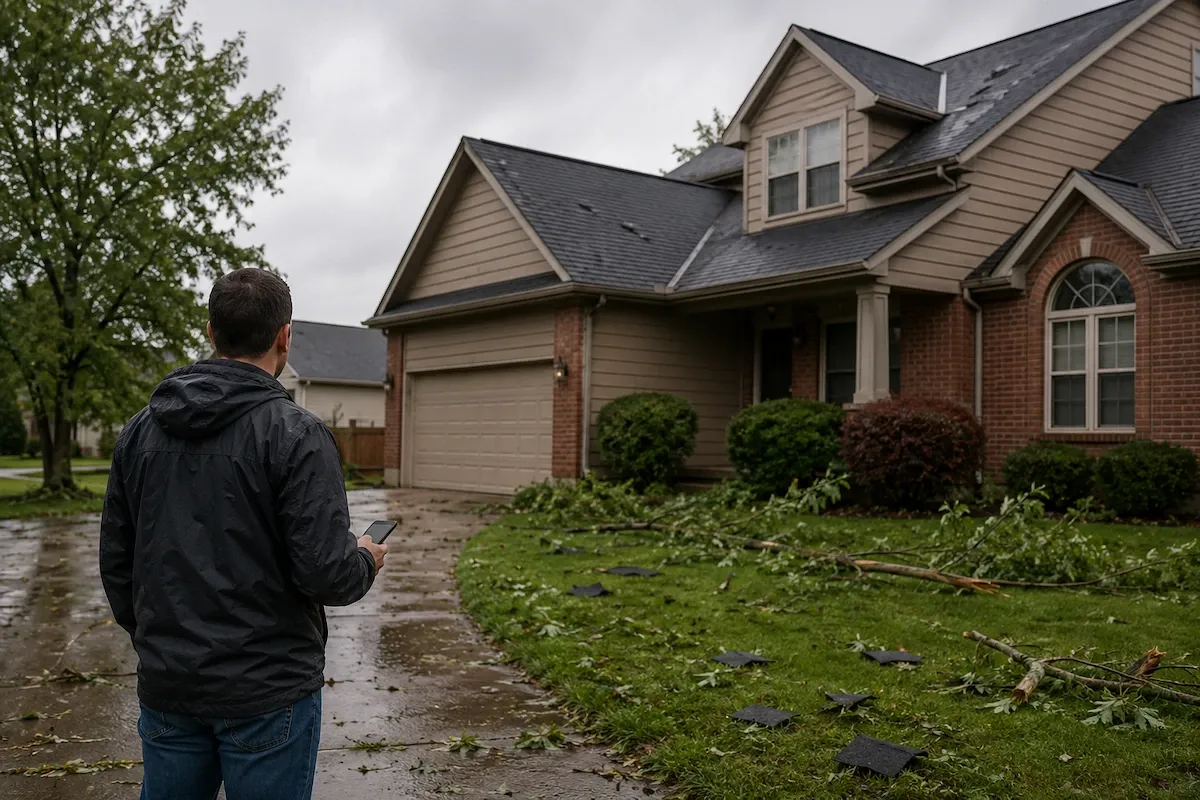
Walk the perimeter. Don’t climb on the roof. About 85% of common roof damage indicators are visible from the ground or with binoculars. Look for shingle granules washed into gutters and downspouts, dented gutters and downspouts, dented or punctured AC condenser fins, dented metal vents and flashing, broken or chipped roof tiles, dings on window sills, dents on the car if it was outside, and dents on outdoor furniture or grills. These are corroborating evidence that hail of damaging size hit your property.
Photograph everything with date stamps. Every modern phone embeds the date, time, and location into the EXIF metadata of the image. Take wide shots and close-ups. Get the same view from multiple angles. If you’re going to make any temporary repairs (tarping a leak, for example), photograph the condition before and after, and keep the receipts.
Notify your insurer in writing. Even if you haven’t yet had a roof inspection, get the claim opened. Many policies require notice within 30 to 60 days. Some Texas policies impose a strict 1-year notice deadline. Email or the carrier’s online portal both create a timestamped record that protects you later.
Step Two: The Roof Inspection
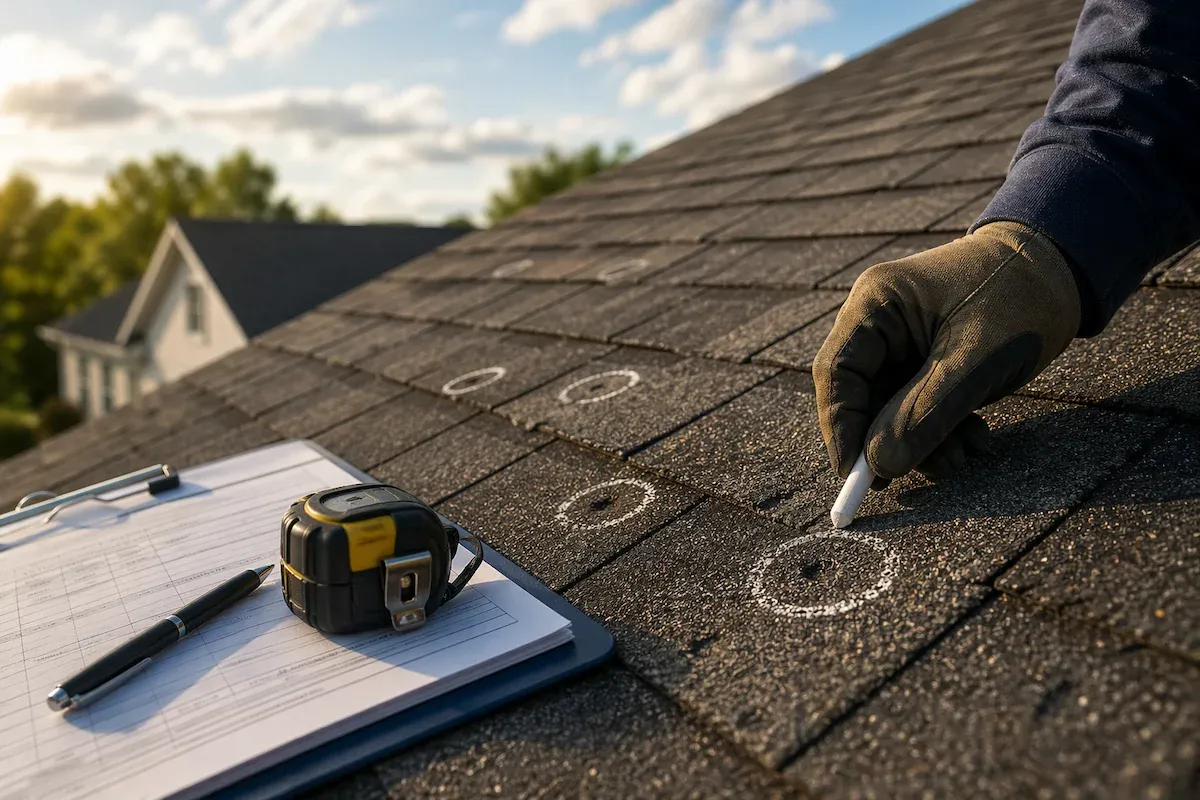
Once the property is documented from the ground, you need a licensed roofer to perform a chalk-circle inspection on the roof itself. A proper inspection covers each slope of the roof, identifies hail strike density (number of impacts per 10x10 square), notes the size and pattern of the strikes, and documents any related damage to flashing, vents, ridge cap, and pipe boots.
A few things to know about how this works in practice:
Use a licensed local roofer, not the first person who knocks on your door. Storm-chaser scams spike in every region after a major hail event. A reputable inspector won’t pressure you to sign a contingency contract on the spot, won’t offer to “cover your deductible,” and will hand over a detailed written report regardless of whether you hire them for the work. We cover the full scam pattern in our guide on storm chasers and roofing scams.
Get the inspection in writing. A verbal “yeah, that’s hail damage” is worth nothing in a claim file. You want a typed report with photos, hail strike counts per slope, identified collateral damage, and a specific scope of repair with line items.
Don’t sign an Assignment of Benefits (AOB). In an AOB, you sign over your insurance rights to the contractor, who then bills the insurer directly and retains any settlement money. AOBs are how a lot of homeowners end up with sloppy work and no recourse. Florida banned them for property claims in 2022 (SB 2A) precisely because of widespread abuse.
If you need a starting point, find licensed roofers in your area to compare options. Our guide on how to choose a roofing contractor walks through verification step by step.
Step Three: Understand Your Policy Before the Adjuster Arrives
This is where most homeowners get blindsided. The two most important policy terms on a roof claim are your settlement basis (ACV vs. RCV) and your deductible structure (flat dollar vs. percentage).
ACV vs. RCV: The Difference Can Be Five Figures
| Settlement Basis | What It Pays | Real-World Math (15-year-old roof, $20,000 replacement, $2,000 deductible) |
|---|---|---|
| Actual Cash Value (ACV) | Replacement cost minus depreciation, minus deductible. Depreciation is permanent. | $20,000 - $10,000 (50% depreciation) - $2,000 = $8,000 payout. You pay $12,000 out of pocket. |
| Replacement Cost Value (RCV) | Replacement cost minus deductible. Insurer pays ACV first, then releases recoverable depreciation when work is completed. | Initial: $20,000 - $10,000 - $2,000 = $8,000. After work completed and depreciation released: total $18,000. You pay $2,000 out of pocket. |
The depreciation gap on a 15-year-old roof is typically 40% to 60% of replacement cost. On a $20,000 roof, that’s $8,000 to $12,000 you either receive or don’t receive based on three letters in your policy.
Many carriers in hail-heavy markets are now automatically converting older roofs to ACV settlement at the 10 or 15 year mark, even on policies that were originally written as RCV. Some apply roof-age schedules that reduce RCV eligibility year by year. Texas and Florida are leading this trend. Read your declarations page now, before a storm hits, and ask your agent what triggers an ACV conversion.
Percentage Deductibles in Wind/Hail States
In hail-prone and hurricane-prone states (TX, FL, CO, OK, KS, NE, AL, LA, MS, NC, SC, GA), most policies carry a separate wind/hail deductible expressed as a percentage of dwelling coverage, often 1% to 5%. On a $400,000 dwelling, a 2% wind/hail deductible is $8,000, not the $1,000 or $2,500 flat deductible you might expect from your “regular” deductible. This shows up on your declarations page, but it surprises homeowners every year.
For a deeper look at what a roof actually costs in 2026 (the number your insurer should be paying for replacement), see our 2026 roof cost guide.
Step Four: Working With the Adjuster
When the insurance adjuster arrives, three things determine how the inspection goes.
Be there in person. You or your roofer (ideally both) should be on-site during the adjuster’s inspection. This is the single most cited piece of advice from public adjusters and policyholder attorneys, because it lets you walk the adjuster through every documented impact and challenge any item they’re inclined to skip.
Have your own estimate already. A typed, line-item estimate from a licensed local roofer (with materials brand and product line, labor, tear-off, decking allowance, permits, and dump fees) is your benchmark. If the adjuster’s number comes in significantly lower, you have a defensible counter.
Insist on a full inspection of every slope. Some adjusters spot-check one or two slopes and extrapolate. Hail damage is rarely uniform. The slopes facing the storm direction take far more damage than the leeward slopes. You want every slope evaluated.
Don’t accept “matching” denials at face value. When only some slopes are damaged, insurers often pay only for the damaged sections, leaving you with mismatched shingle colors. State law varies on whether the carrier owes you matching siding, roofing, or other materials. Colorado courts have ruled in favor of cosmetic matching coverage in some cases (see Bertisen v. Travelers, D. Colo. 2024). Other states are less generous. Your policy language is the controlling document, and ambiguous “like kind and quality” language sometimes works in your favor.
When to Hire a Public Adjuster
A public adjuster represents you, not the insurance company, and is paid as a percentage of your settlement (commonly 10% to 20%, with state-specific caps). In Florida, the cap is 10% of insurance proceeds during a declared state of emergency for the first year, and 20% otherwise (Fla. Stat. §626.854).
Public adjusters tend to earn their fee on:
- Large claims (typically $25,000+)
- Complex policies with multiple endorsements
- Claims that have already been denied or significantly underpaid
- Catastrophic losses (full or near-full roof replacement)
For straightforward claims well under coverage limits, a licensed independent roofer providing a detailed written estimate is often enough leverage on its own.
What you don’t want to hire is a “public adjuster” who showed up the day after the storm with a clipboard. Verify any public adjuster’s state license through your state’s Department of Insurance lookup tool, and avoid anyone who pressures you to sign immediately.
Mitigation: The Discount Almost Nobody Claims
The single best long-term move on insurance cost is mitigation. Insurance Information Institute analysis cited in their April 2026 brief notes that every $1 invested in hazard mitigation can save up to $33 in future disaster costs.
The most established mitigation standard is the IBHS FORTIFIED program, developed by the Insurance Institute for Business & Home Safety. There are three designation tiers, each verified by an independent third-party evaluator, and most coastal states (and increasingly inland hail states) offer mandated or filed discounts on the wind portion of premium for FORTIFIED-designated homes.
| FORTIFIED Tier | What It Strengthens | Alabama Wind Premium Discount |
|---|---|---|
| FORTIFIED Roof | Roof system: sealed deck, enhanced fastening, code-plus underlayment, drip edge, ring-shank nails | 25% to 35% |
| FORTIFIED Silver | Roof tier plus reinforced windows, doors, gable ends, attached structures | 35% to 45% |
| FORTIFIED Gold | Silver tier plus continuous load path tying roof to walls to foundation | 45% to 55% |
Discounts in other states vary. Mississippi has filed discounts of 15% to 30%. Louisiana, North and South Carolina, Texas, and Florida all have growing FORTIFIED programs with carrier-specific schedules.
Beyond FORTIFIED, two simpler mitigation moves earn discounts in most hail-heavy states:
- Class 4 impact-resistant shingles: rated for the highest impact resistance (UL 2218 Class 4). Many insurers in TX, OK, CO, KS, and other hail states offer 10% to 35% discounts on the wind/hail portion of premium for Class 4 roofs. The Colorado Division of Insurance estimates a hail-resistant roof saves homeowners $82 to $387 per year.
- Wind mitigation inspection (Florida Form 1802): a $50 to $125 inspection that documents existing wind-resistant features and unlocks credits that often save 30% to 60% on the wind portion of premium.
The IBHS post-Hurricane Sally study found FORTIFIED homes sustained roughly 22% less damage severity than non-FORTIFIED homes in the same wind field. The premium discount and the lower out-of-pocket exposure stack on top of each other.
State-Specific Rules That Trip Homeowners Up
Hail claim rules vary substantially by state. Here are the ones that catch the most homeowners by surprise.
Texas
Texas has the most aggressive hail litigation environment in the country, which is why it also has the most restrictive policy language. Key facts:
- Statute of limitations: 2 years from the date of loss (or denial) for first-party property lawsuits (Tex. Ins. Code §16.003).
- Notice requirement: Most policies require notice within a “reasonable time,” which courts have interpreted as 30 to 60 days. Some policies impose an explicit 1-year notice deadline.
- HB 1774 (2017): Reduced statutory penalty interest from 18% to roughly 10% on §542A first-party claims, requires 61-day pre-suit notice with a specific damages statement, and changed how attorney’s fees are recovered.
- Carrier acknowledgment: Insurers must acknowledge a claim within 15 days and accept or reject within 15 business days after receiving requested information.
- ACV creep: Most major TX carriers now apply ACV settlement to roofs over a certain age (often 10 to 15 years), even on policies originally written as RCV.
Texas residents in hail country: read our Dallas storm risk profile for context on how often hail hits.
Colorado
Colorado homeowners insurance premiums have risen 65% in the last five years, and according to the state Division of Insurance, 60% to 70% of every premium dollar statewide is attributable to hail risk, even in parts of the state that rarely see hail.
- Cosmetic matching: Colorado courts have generally favored homeowners on matching disputes. Bertisen v. Travelers (D. Colo. 2024) held that ambiguous “like kind and quality” policy language can require cosmetic matching when materials are no longer manufactured. However, many Colorado carriers (Allstate, American Family) now include explicit matching exclusions, so policy language controls.
- SB 155 (2026 session): Would create a state grant program for hail-resistant roofs funded by a 0.5% carrier fee. Status pending as of April 2026.
- Class 4 discounts: CO Division of Insurance figures show hail-resistant roofs save homeowners $82 to $387 per year in premium.
See the Denver storm risk profile and Colorado Springs profile for hail frequency details.
Florida
Florida’s roof rules are the most complex in the country. The headline:
- Fla. Stat. §627.7011: An insurer cannot refuse to renew solely on the basis of roof age if a roof inspection shows the roof has 5 or more years of useful life remaining.
- SB 808 (effective July 1, 2026): Expands who can perform the qualifying roof inspection to include licensed home inspectors and building inspectors.
- SB 128 (2026 session): If passed, would require the insurer to reimburse the homeowner up to $300 for the qualifying inspection.
- AOB ban (SB 2A, 2022): Florida eliminated assignment of benefits for property claims, ending one of the largest sources of post-storm contractor abuse.
Florida-specific roofing strategy is its own subject. We cover materials, codes, the Citizens insurance market, and HVHZ requirements in best roofing for Florida homes.
When NOT to File a Claim
Filing a claim is not always the right move. The decision tree:
Skip the claim if any of these are true:
- The estimated repair cost is at or below your deductible.
- The damage is purely cosmetic and your policy excludes cosmetic-only damage.
- You’ve already had multiple claims in the last 3 to 5 years and another one risks non-renewal.
- The roof is at end-of-life and you were planning to replace it anyway out of pocket. (In this case, the better play is often to upgrade to a Class 4 or FORTIFIED-grade roof to lock in the premium discount.)
File the claim if:
- Documented damage clearly exceeds your deductible by a meaningful margin.
- The damage is functional, not just cosmetic.
- A licensed roofer’s written estimate confirms the scope of work.
- You’re inside your policy’s notice deadline and the state statute of limitations.
A useful sanity check: if you’re not sure whether the damage is enough to file, get an independent inspection from a licensed local roofer first. They can tell you whether the damage will trigger a payout that exceeds your deductible. For more on the repair-vs-replacement decision when damage is borderline, see our repair vs replacement guide.
The Documentation Checklist (Print This Before the Next Storm)
Use this list as your post-storm playbook. Most of it costs nothing and prevents thousands in lost recovery.
Before the storm:
- Save a current declarations page (PDF) and read it. Note your dwelling coverage, deductible (flat and wind/hail percentage), and ACV vs. RCV designation.
- Photograph every slope of your roof in good condition with date-stamped images. Save them off-device (cloud or email to yourself).
- Photograph siding, windows, gutters, AC units, and outdoor structures.
- Inventory any high-value outdoor items.
Within 48 hours of the storm:
- Save the NOAA Storm Events record or local NWS confirmation showing hail at your address.
- Photograph all visible damage from the ground (wide and close-up).
- Make any necessary emergency repairs (tarping) and keep receipts.
- Notify your insurer in writing, even if you haven’t yet completed an inspection.
Within 7 days:
- Schedule a licensed local roofer for a chalk-circle inspection.
- Get the inspector’s typed report with photos and a line-item scope estimate.
- Schedule the insurance adjuster’s inspection.
During the adjuster’s inspection:
- Be on site (or have your roofer there).
- Walk every slope with the adjuster.
- Provide your roofer’s estimate as a benchmark.
- Take notes on what the adjuster does and doesn’t document.
After the adjuster’s report arrives:
- Compare line by line against your roofer’s estimate.
- Dispute any missed items in writing.
- If the gap is significant, consider invoking the policy’s appraisal clause or hiring a public adjuster.
- Track all deadlines: notice, proof of loss, repair completion (for recoverable depreciation), and statute of limitations for litigation.
The Bottom Line
A hail damage claim is rarely about whether the damage exists. It’s almost always about how it’s documented, how the policy is interpreted, and whether you have the right paperwork in front of the right people at the right time.
Two things matter more than anything else:
-
Read your policy now. Specifically, confirm your settlement basis (ACV or RCV), your wind/hail deductible (flat dollar or percentage of dwelling), and any roof-age conversion clauses. If you don’t like what you see, talk to your agent about endorsements before the next storm, not after.
-
Use a licensed local roofer. Storm chasers cost homeowners millions every year through inflated bids, fraudulent claims, shoddy installations, and disappearing acts. A local roofer with a verifiable license, real reviews, and a physical address is the single best defense against the bad parts of the claim process.
Get Your Roof Inspected and Quoted by a Licensed Local Roofer
If you’ve been hit by hail, the next move is a written, line-item inspection from a licensed local roofer who isn’t trying to sell you on signing a contract today. Find top-rated roofers in your area on Roofer Directory, compare ratings and reviews, and connect directly with professionals who serve your zip code. You can also request a free estimate from a local contractor.
For more on how to vet a roofer and avoid post-storm scams, read our guides on how to choose a roofing contractor and storm chasers and roofing scams. For everything else (terms, definitions, common questions), our FAQ and glossary covers the rest.
A few more answers.
What is the average insurance payout for a hail-damaged roof in 2026?
Industry data points to roughly $12,000 as the average hail roof payout, based on State Farm's most recent published claims data. Insurance Information Institute (Triple-I) figures put the wind/hail claim severity at $14,747 in 2023, and severe convective storms generated $51 billion in U.S. insured losses in 2025. Your specific payout depends on roof size, materials, deductible, depreciation, and whether your policy is ACV or RCV.
What's the difference between ACV and RCV on a roof claim?
Actual cash value generally accounts for depreciation; replacement-cost coverage can provide additional payment for eligible replacement under the policy’s conditions. Your deductible still matters. Ask about depreciation calculations, repair deadlines and what documentation is required before assuming the full replacement cost will be paid.
How long do I have to file a hail damage insurance claim?
It depends on your state and your policy. In Texas, the statute of limitations is two years from the date of loss for a lawsuit, but most policies require notice within 30 to 60 days and a sworn proof of loss within 60 to 91 days. Some Texas policies impose a one-year notice deadline. Florida and Colorado have their own rules. The safest move is to notify your insurer in writing as soon as you suspect damage, even if you haven't completed a full inspection yet.
Should I file a hail damage claim if the damage is small?
Often no. If your repair estimate is at or below your deductible, you'll pay the full cost out of pocket and still have a claim on your record, which can affect future premiums or insurability. The general guideline: file when documented damage clearly exceeds your deductible by a meaningful margin and a licensed contractor confirms the damage is functional, not just cosmetic.
How do I document hail damage for an insurance claim?
Photograph and video the damage from the ground first (wide shots and close-ups), then have a licensed roofer perform a chalk-circle inspection on the roof. Save dated photos of the storm damage to gutters, downspouts, vents, AC fins, window screens, and any vehicles or outdoor furniture in the same area. Keep all receipts for emergency tarping or temporary repairs. The more contemporaneous evidence you have, the harder it is for an adjuster to argue the damage came from a different storm or is pre-existing.
Should I hire a public adjuster for a hail damage claim?
A public adjuster works for you, not the insurer, and negotiates the claim in exchange for a percentage of the settlement (commonly 10% to 20%, capped by state law). They tend to be most useful on large claims, complex policies, or after an initial denial or lowball offer. For straightforward claims well under your coverage limits, a licensed independent roofer providing a detailed estimate is often enough. In Florida, public adjuster fees are capped at 10% of insurance proceeds during a declared emergency for the first year.
What is an IBHS FORTIFIED roof and is it worth the cost?
FORTIFIED is a voluntary construction standard from the Insurance Institute for Business & Home Safety (IBHS) that strengthens the roof system against wind, hail, and water intrusion. There are three tiers: Roof, Silver, and Gold. In Alabama, where premium discounts are mandated by statute, a FORTIFIED Roof earns 25% to 35% off the wind portion of premium, Silver 35% to 45%, and Gold 45% to 55%. IBHS research after Hurricane Sally found FORTIFIED homes saw roughly 22% less storm damage severity than comparable code-built homes.
Will filing a hail claim cause my insurance to go up or get cancelled?
A single hail claim usually does not get a policy cancelled, especially in catastrophe-declared events where insurers expect a surge of claims. However, multiple claims within a short window (typically 3 to 5 years) can lead to non-renewal, and rates often increase at renewal regardless. In Florida, age-related and condition-related non-renewals are governed by Florida Statute 627.7011 and the 5-year useful life test. Documenting that your claim was a sudden, covered event (not deferred maintenance) is critical to keeping your policy in force.
What is recoverable depreciation and how do I get it back?
On an RCV policy, the insurer typically pays you the actual cash value first (replacement cost minus depreciation, minus deductible), then releases the recoverable depreciation portion after you complete the repairs and submit final invoices. Most carriers give you 180 days to a year to complete the work and claim the depreciation. Miss the deadline and that money stays with the insurer.
Can the insurer require me to use their preferred contractor?
No. Carriers can recommend or refer contractors, but they cannot legally force you to use a specific roofer in any U.S. state. You have the right to choose your own licensed contractor, and a written estimate from an independent licensed roofer is one of the strongest tools for negotiating a fair settlement when the adjuster's estimate comes in low.
What should I do if my hail claim gets denied or underpaid?
Request the denial in writing with the specific policy language relied on. Get an independent inspection from a licensed roofer (not a storm chaser). If the gap is meaningful, hire a public adjuster or consult an attorney experienced in first-party property claims. Most state insurance departments accept consumer complaints, and many policies include an appraisal clause that lets you force a binding cost determination through neutral appraisers. Watch your deadlines: Texas gives you two years from denial to file suit, and other states have similar windows.
More questions? Browse the roofing FAQ & glossary.
Selected FAQ answers reviewed .
Published by RooferDirectory. Learn about our sources and methods, or suggest a correction.