
In this guide
At a glance.
- A roofing square is 100 square feet of roof surface; bundles per square depend on the shingle product.
- Current US GAF sheets list three bundles per square for Timberline HDZ and four for Woodland.
- Check field shingles separately from starter and hip/ridge products when reviewing a delivery.
A roofing square is 100 square feet of roof surface, but the bundle count depends on the shingle. GAF lists three bundles per square for Timberline HDZ and four for Woodland. Check the exact product and its package coverage before treating either figure as an ordering rule.
That quick answer helps you read an estimate. It does not finish the material calculation. The measured roof area, allowance for cuts, actual packages and separate accessories all need to make sense together.
You do not need to become the crew’s material estimator. You should be able to follow the numbers from the roof measurement to the order, then recognize whether the delivery matches what was agreed.
A square measures area; a bundle is a package
A square is an area unit used in roofing: 100 square feet. A bundle is a package of shingles. GAF’s August 2026 bundle guide explains that package coverage varies by product. The two words are not interchangeable.
The current US Timberline HDZ specification lists 3 bundles per square. The Woodland data sheet lists 4 bundles per square. Those are named product examples, not a ranking of shingle quality.
One roofing square means 100 square feet of roof area.
If an estimate says only “shingles,” you cannot check its bundle assumption yet. Get the full product line first. A manufacturer name alone is not enough, as these two examples from the same company show.
Keep the selected color with that product name in your records too. This gives you a specific item to compare with the order and delivery, instead of trying to remember which sample everyone liked.
Start with the roof area being measured
Use the roof measurement supplied for the project, not the home’s advertised floor area. GAF’s bundle guide distinguishes sloped roof surface from the house footprint. It also separates base coverage from allowances for cuts and waste.
Your job is to understand what the measurement includes. Does it cover the garage roof? The porch? An addition? If the project excludes one of those areas, have the material calculation identify the same boundary.
For example, imagine the roof report covers the house and detached garage, but this year’s job covers only the house. A calculation based on the whole report would answer a different question from the current proposal. Confirm the included areas before debating the number of bundles.
Also check the unit beside the number. “18 squares” and “18 bundles” describe different quantities. Write the unit every time you copy a figure into an email or comparison note. A missing word can do a remarkable amount of mischief in a spreadsheet.
If the estimate and supplier record use different units, request a version showing both. For instance, a fictional order might describe a product in squares while the delivery ticket counts its bundles. The numbers need not match to be consistent. What you need is the conversion for that exact product, carried through the same order. Do not “correct” one document by copying a number from the other without its unit.
Our new-roof cost guide explains the broader estimating context. Here, keep your attention on the quantity trail: included roof surface, selected product and final order.
Work through one provisional example
Consider an invented roof measurement of 1,800 square feet. Dividing by 100 gives 18 roofing squares.
Using the two manufacturer-listed ratios produces this comparison:
| Named product | Listed bundles per square | Nominal multiplication |
|---|---|---|
| Timberline HDZ | 3 | 18 × 3 = 54 bundles |
| Woodland | 4 | 18 × 4 = 72 bundles |
These are provisional illustrations before allowances and verification of the actual packages. They are not purchase recommendations or promises of exact installed coverage. Their purpose is to show why changing the product can change the package count even when the measured area stays the same.
Do not compare those two totals and conclude that one contractor ordered too much. First confirm that both proposals use the same roof area and product. Then compare how each treats the project allowance and accessories.
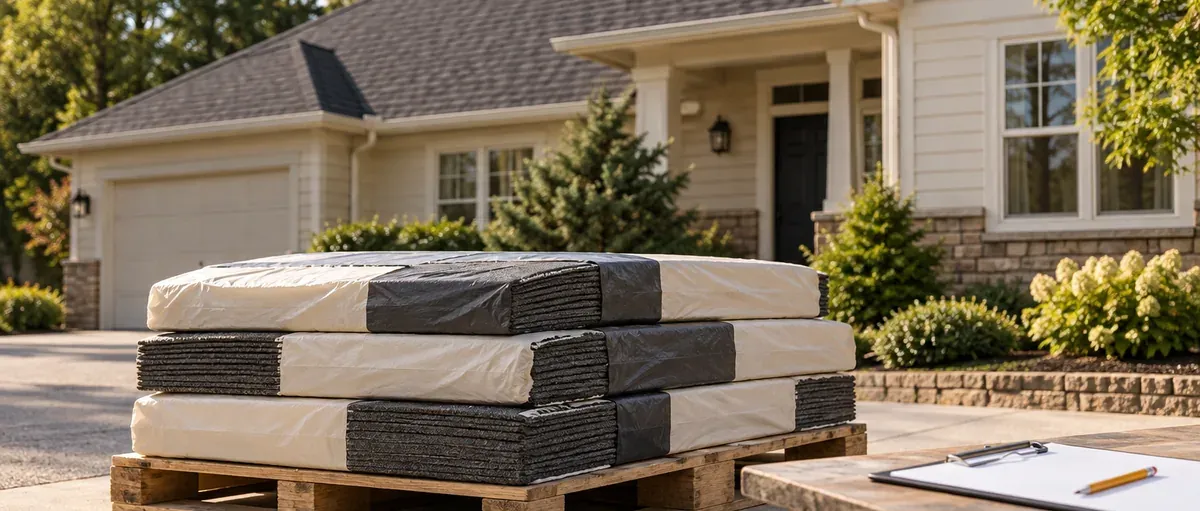
The reverse calculation also has limits. Seeing 54 packages in a delivery does not establish that your roof is 18 squares. You would first need to know what those packages contain and what the order already allows for. A stack on the driveway is not a measurement report.
Follow the allowance through to the final count
For the final order, keep the calculation’s inputs separate:
- Measured roof area: The surfaces included in the job.
- Project allowance: Extra coverage the estimator includes for that job.
- Package coverage: The amount stated for the selected product’s actual package.
- Whole bundles: The final quantity after rounding upward.
The arithmetic is straightforward: add the agreed allowance to the measured area, divide by the selected package’s stated coverage, then round the final result up to whole bundles. If the allowance is expressed differently, have the estimator show how it enters the calculation.
Keep intermediate figures unrounded. Rounding the area, then the allowance, then the packages can make a simple calculation harder to reconcile. You want to see where the final whole-bundle number came from.
There is another easy mistake: adding an allowance twice. Suppose the material list already says “quantity includes project allowance.” Multiplying that quantity again by your own allowance would count extra material twice. Find out what is already included before adjusting anything.
If a number changes during planning, ask which input changed. A revised measurement, different product or corrected allowance should have an identifiable place in the calculation. Save the revised list so an older version does not become the delivery-day reference by accident.
This is a way to check the explanation. It does not establish the right allowance for your particular roof, and it does not replace the contractor’s material estimate.
Keep main shingles and accessories on separate lines
Field shingles cover the main roof surfaces. Starter products at the edges and hip/ridge caps at roof peaks and angled intersections are separate categories. GAF’s July 2026 roof-replacement guide identifies distinct roof components and calls for the proposal to identify materials and work.
A delivery can contain several kinds of packages. Adding all of them together does not tell you the field-shingle coverage. Compare each category against its own line on the material list.
For a fictional example, imagine you count the expected field-shingle bundles, plus several packages labeled as starter and ridge products. Those additional packages do not mean the field-shingle order is excessive. They answer different lines on the list.
Equally, a matching grand total does not prove the delivery is correct. One category could be short while another differs. Keep names and quantities paired, rather than treating every wrapped package as interchangeable.
Check the delivery record against the agreed list
Owens Corning’s January 2026 professional specification calls for unopened manufacturer packages with intact, legible labels. That is a named specification, not a universal storage rule. For your own check, obtain clear label photos and the delivery record from the contractor or supplier.
The fictional example below shows a name mismatch, not a proven supplier error. The useful action is to reconcile it before the material is installed.
The names do not match. Ask which one is correct before it is used.
A difference may have an explanation, such as a revised selection that did not reach your copy of the list. Have the contractor identify the change and supply the current record. Do not approve a substitute merely because the package looks similar.
When sending a question, identify the line and attach the relevant label photo. “The starter line says A, but this label says B” gives the company something specific to resolve. Keep its answer with the list. A broad message saying the delivery looks wrong is harder to investigate and easier to misunderstand.
You can do this review through paperwork and photos from the ground. There is no need to climb onto the roof, open packages or move heavy bundles to satisfy a personal recount.
Settle leftover and spare-material questions early
Before delivery, ask who will handle damaged packaging, incorrect items and unused material. Also distinguish material intentionally kept as spares from material left over after the work. Those are different decisions, even if both end with bundles at your house.
Request the actual return arrangements and any relevant contract terms rather than assuming a standard policy. Who owns unused material? Who arranges collection? Are any charges involved? Get the answers from the parties responsible for your order.
Keep the final material list, delivery record and agreed changes with the project paperwork. A clear record is more useful than a photo of an unexplained stack, especially if a quantity question comes up after the crew has finished.
Compare estimates with the same material details
Browse roofing companies on Roofer Directory and request an estimate from businesses you have checked. Give each company the same project scope, and verify applicable licensing or registration and insurance yourself.
Our contractor selection guide and roofing FAQ can help with the next conversation. Bring the product name and material list; the bundle count will be much easier to discuss.
Published by RooferDirectory. Learn about our sources and methods, or suggest a correction.