
In this guide
At a glance.
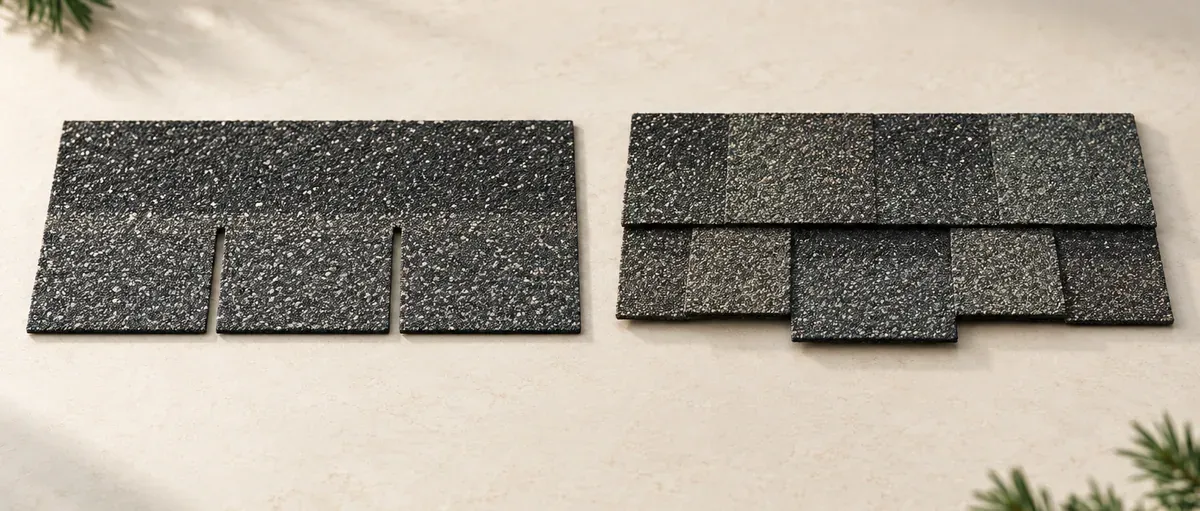
- Three-tab shingles have a repeating flat face; architectural shingles use laminated pieces to create depth.
- A style label does not establish a product's wind rating, impact rating or warranty terms.
- Compare exact products and the complete work included before deciding what an upgrade costs.
Architectural shingles use layered construction for a dimensional look; 3-tab shingles have a flat, repeating face. That is the starting difference. Choose between the exact products available for your project, with their documented ratings, warranty terms and complete installed proposals in view.
Do not let “architectural” stand in for every possible performance feature, or assume “3-tab” tells you one universal lifespan. Those labels describe a type of shingle. They do not identify everything you are buying.
Two real manufacturer documents below show why that matters: the named products share listed wind-test classes, yet their wind-warranty terms differ. Understanding the difference is more useful than memorizing a general better-versus-cheaper chart.
See what changes in the shingle itself
Owens Corning’s February 2026 shingle overview describes three-tab shingles with three equal tabs. Architectural shingles are also called dimensional or laminated shingles. Laminated means pieces are bonded together.
GAF’s updated shingle-type guide distinguishes a flat strip from layered architectural construction. Those layers are within the shingle itself. They do not mean installing a second complete roof over an old one.
Use actual samples to decide which appearance you prefer. Then attach that preference to a manufacturer and product name. An estimate that says only “architectural shingles” leaves the selection unfinished.
For example, if you want a layered look, that points you toward the architectural category. It does not yet tell you whether a proposed model has a particular impact classification or qualifies for the warranty being described. Keep those as separate checks.
Read two real products without turning them into averages
Owens Corning’s February 2026 Supreme brochure supplies a three-tab example. Its August 2026 Duration brochure supplies a laminated example. Both list ASTM D3161 Class F and ASTM D7158 Class H wind classifications.
The brochures cover different service regions. This is a comparison of documents, not a claim that both products are available together in your ZIP code. Confirm the exact local product before using either example in a buying decision.
For wind coverage, the August 2026 Owens Corning warranty applies to purchases after August 1, 2026 until superseded.
Wind-warranty terms60 mph for 5 years.
Wind-warranty terms130 mph standard, for 15 years.Up to 160 mph with enhanced requirements.
Enhanced Duration coverage requires specified components and installation. Wind coverage starts after thermal sealing, when heat bonds the sealing strips. Confirm eligibility in the full warranty.
This example shows why a comparison needs more than one column. A matching test class does not mean matching coverage. Different coverage does not, by itself, quantify how two roofs will perform at your house.
Keep wind, impact and fire ratings separate
The Asphalt Roofing Manufacturers Association’s November 2025 standards explanation distinguishes the test methods. ASTM D3161 uses a fan-based wind test; D7158 evaluates uplift resistance. F and H are the highest classes within those respective methods. They are not interchangeable wind-warranty speeds.
Fire and impact classifications answer other questions. A fire classification concerns external-fire testing of a roof assembly. An impact classification concerns a different laboratory test. None is a promise that a roof will escape every real storm or fire.
The specific Duration brochure above also lists Class 3 impact resistance. That is a documented feature of the named example, not a feature you should assign to every architectural shingle. Do not assign Supreme an impact classification that its brochure does not provide.
Imagine a fictional sales conversation in which someone says, “This one is Class A, so it is the better hail option.” The next question is which test the letter describes. A classification can be valid and still be irrelevant to the comparison being made.
You do not need to memorize the standards. Keep the test name beside the class when taking notes. If a recommendation depends on a rating, have the contractor show where that exact product lists it and explain why it matters for your project.
A style name cannot supply an expiration date
The Insurance Institute for Business & Home Safety (IBHS), in its September 2026 aging research, found different later wind behavior among products sharing the highest initial wind classification. Climate, roof orientation and the condition of shingle seals mattered. The study is not a direct comparison of the Supreme and Duration examples used here.
That limits what you can conclude from a new-product label. It does not establish that all architectural shingles last a certain number of years longer than all three-tab shingles, or that either family has one replacement age.
Keep a claim about lifespan separate from a documented rating. If a proposal promises a specific service life, request the basis for that exact statement. A warranty heading or a different homeowner’s roof is not automatically evidence for the same outcome on your house.
Our roof lifespan guide covers the broader condition-and-age discussion. For this selection, focus on what the proposed product documents actually establish.
Read the warranty periods by what they cover
Warranty duration is not roof life. Under this Owens Corning warranty, lifetime coverage, where offered, applies while an individual owns and lives in the detached single-family home. Coverage can reduce over time.
When comparing offers, keep the covered issue beside its period. Do not write “longer warranty” in your notes without recording what is longer. Otherwise, you may compare one product’s defect term with another’s wind coverage and think you have compared like with like.
Request the actual warranty version proposed for the job and an explanation of how the quoted system qualifies. Keep any workmanship warranty from the contractor identifiable too, rather than folding every promise into one number.
You are not trying to predict a future claim. You are making sure the terms being used to sell today’s project are the terms you have actually received. A brochure headline has a much easier job than the full document.
Find the price difference for the same work
GAF’s July 2026 replacement-scope guide recommends a proposal that identifies materials, work and terms. Shingles are only part of it: underlayment, flashing, ridge caps, removal and damaged decking can also affect what the work includes.
For a useful comparison, request two clearly identified product options against the same defined project. Have any other required changes named separately. Then you can see whether the difference concerns the shingle selection alone or a different package of work.
Consider a fictional pair of proposals. One names a three-tab product. The other names an architectural product and also includes additional work. Subtracting the totals does not isolate the price of changing shingles. You would be subtracting different projects.
The solution is not to demand that both contractors use identical wording. It is to resolve the actual differences. Mark the work that is shared, the product that changes and any work included in only one option. Ask for clarification where the reason is unclear.
Our asphalt-shingle replacement cost guide can help with the wider budget discussion. Use actual same-scope proposals for this house rather than applying a supposed universal upgrade percentage.
Choose for the priority you actually have
The following are fictional decision examples, not product recommendations.
If appearance is your main priority, compare actual samples and identify the model that gives you the look you prefer. Then check its documented requirements and complete project price. Liking the layered appearance is a valid preference; it does not require claiming that every layered shingle wins every technical comparison.
If the budget is tight, request a clearly specified option that the contractor considers suitable for your project. Compare its full scope with the alternative before deciding what to remove or change. A low total without a named product and defined work leaves too much unknown.
If weather performance is the concern, identify the particular feature you want documented. Wind and impact are different questions. Have the professional connect the recommendation to the exact product evidence and project requirements instead of treating the word “architectural” as the answer.
Suppose you prefer the dimensional sample but have not seen a separate price for that option. The useful next step is to price that named product against a clear alternative. You do not need to decide whether every architectural shingle is “worth it” before comparing two real offers. If the difference fits your budget and the look matters to you, that is a reason grounded in your priorities. If it does not, return to a documented suitable alternative. The decision should reflect your house and proposal, not pressure to pick a label.
More than one option may meet your needs. Once the choice is made, keep the product name, specification, selected proposal and warranty version together. Any later substitution should be explained against that record before you agree to it.
Compare exact options with local roofers
Browse roofing companies on Roofer Directory, then request an estimate from businesses you have checked. Verify applicable licensing or registration and insurance yourself, and bring the same product and scope questions to each conversation.
Our contractor selection guide and roofing FAQ can help you prepare. The useful comparison ends with an identifiable product and a clear project, not just a style label.
Published by RooferDirectory. Learn about our sources and methods, or suggest a correction.